


Page 28 - UR221 Creative & Scientific Thinking_Neat
P. 28
2.16 Critical Thinking in Problem Solving
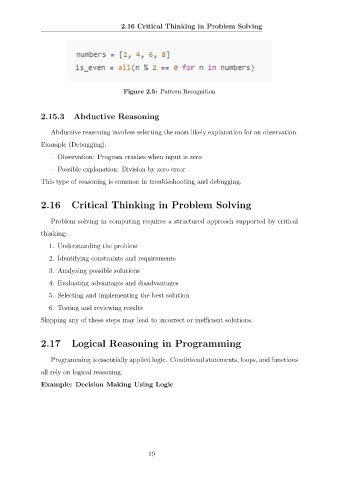
Figure 2.5: Pattern Recognition
2.15.3 Abductive Reasoning
Abductive reasoning involves selecting the most likely explanation for an observation.
Example (Debugging):
bservation: Program crashes when input is zero O
ossible explanation: Division by zero error P
This type of reasoning is common in troubleshooting and debugging.
2.16 Critical Thinking in Problem Solving
Problem solving in computing requires a structured approach supported by critical
thinking:
1. Understanding the problem
2. Identifying constraints and requirements
3. Analyzing possible solutions
4. Evaluating advantages and disadvantages
5. Selecting and implementing the best solution
6. Testing and reviewing results
Skipping any of these steps may lead to incorrect or inefficient solutions.
2.17 Logical Reasoning in Programming
Programming is essentially applied logic. Conditional statements, loops, and functions
all rely on logical reasoning.
Example: Decision Making Using Logic
19

