


Page 3 - Market Outlook Q3 2025
P. 3
Q3, 2025
                                                                                                                 3

        North American Trailer


        Economic Overview


        Per the  Bloomberg Forecast  Panel’s latest  update, the  personal   In the retail sector of the economy, sales and inventories appear to be
        consumption  expenditures  price  index  excluding  food  and  energy,   getting back in sync for the first time since the pandemic. Retail year-
        which is the Fed’s preferred measure of inflation, is likely to average   to-year sales growth was at or below zero through most of 2023 and
        2.8% in the third quarter, and rise to 3.0% in the fourth. The National   2024 but started recovering in the first half of 2025. Sales trended up
        Association for Business Economics panel expects the index to grow   at  a  steady  pace  in  the  third  quarter  and  are  expected  to  continue
        3.3% in the fourth quarter. The Fed’s target rate is 2%.  growing slowly. Inventory growth slowed in first-half 2025 because
                                                               manufacturers realized that their sales growth expectations had been
        Figure 2                                               too high. The sales/inventory cycles in this sector appear to be returning
                            U.S. Real GDP — SAAR               to pre-pandemic historical norms.
                             Annual % Change
          9
                                                               Figure 4
          6
                                                    Forecast
          3
          0
          -3
          -6
           2017  2018  2019  2020  2021  2022  2023  2024  2025  2026
        However, none of the forecast panels expect inflation to prevent
        continued slow growth in U.S. consumer expenditures. The positive
        forecast for consumer expenditures, which is the primary component
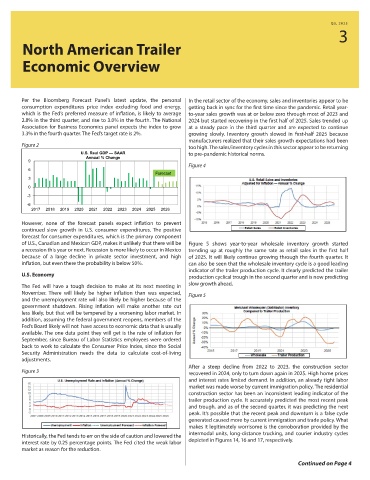
        of U.S., Canadian and Mexican GDP, makes it unlikely that there will be   Figure  5  shows  year-to-year  wholesale  inventory  growth  started
        a recession this year or next. Recession is more likely to occur in Mexico   trending up at roughly the same rate as retail sales in the first half
        because of a large decline in private sector investment, and high   of 2025. It will likely continue growing through the fourth quarter. It
        inflation, but even there the probability is below 50%.  can also be seen that the wholesale inventory cycle is a good leading
                                                               indicator of the trailer production cycle. It clearly predicted the trailer
        U.S. Economy                                           production cyclical trough in the second quarter and is now predicting
                                                               slow growth ahead.
        The Fed will have a tough decision to make at its next meeting in
        November.  There will likely be higher inflation than was expected,   Figure 5
        and the unemployment rate will also likely be higher because of the
        government shutdown. Rising inflation will make another rate cut
        less likely, but that will be tempered by a worsening labor market. In
        addition, assuming the federal government reopens, members of the
        Fed’s Board likely will not  have access to economic data that is usually
        available. The one data point they will get is the rate of inflation for
        September, since Bureau of Labor Statistics employees were ordered
        back to work to calculate the Consumer Price Index, since the Social
        Security Administration needs the data to calculate cost-of-living
        adjustments.
                                                               After  a steep  decline  from 2022  to 2023,  the  construction  sector
        Figure 3                                               recovered in 2024, only to turn down again in 2025. High home prices
                                                               and interest rates limited demand. In addition, an already tight labor
                                                               market was made worse by current immigration policy. The residential
                                                               construction sector has been an inconsistent leading indicator of the
                                                               trailer production cycle. It accurately predicted the most recent peak
                                                               and trough, and as of the second quarter, it was predicting the next
                                                               peak. It’s possible that the recent peak and downturn is a false cycle
                                                               generated caused more by current immigration and trade policy. What
                                                               makes it legitimately worrisome is the corroboration provided by the
                                                               intermodal units, long-distance trucking, and courier industry cycles
        Historically, the Fed tends to err on the side of caution and lowered the
        interest rate by 0.25 percentage points. The Fed cited the weak labor   depicted in Figures 14, 16 and 17, respectively.
        market as reason for the reduction.

                                                                                                    Continued on Page 4

