


Page 141 - Decorative Arts, Part II: Far Eastern Ceramics and Paintings, Persian and Indian Rugs and Carpets
P. 141
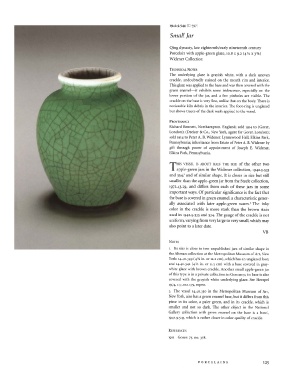
1942.9-544  (C-397)
                                                                       Small Jar


                                                                       Qing dynasty,  late  eighteenth/early  nineteenth  century
                                                                                                            5
                                                                       Porcelain  with apple-green  glaze,  10.8 x 9.2 (4^ x 3 /s)
                                                                       Widener Collection

                                                                       TECHNICAL  NOTES
                                                                       The  underlying  glaze  is  grayish  white,  with  a  dark  uneven
                                                                       crackle,  undoubtedly  stained  on  the  mouth  rim  and  interior.
                                                                       This glaze was applied to the base and was then covered with the
                                                                       green  enamel—it  exhibits  some  iridescence, especially on  the
                                                                       lower  portion  of  the  jar,  and  a  few pinholes  are  visible.  The
                                                                       crackle on the base is very fine, unlike that on the body There is
                                                                       noticeable kiln debris in the  interior. The foot-ring  is unglazed
                                                                       but  shows traces of the dark wash applied to the vessel.

                                                                       PROVENANCE
                                                                       Richard  Bennett,  Northampton,  England;  sold  1914 to  (Gorer,
                                                                       London); (Dreicer & Co., New York, agent for Gorer, London);
                                                                       sold  1914 to  Peter A. B. Widener, Lynnewood Hall, Elkins Park,
                                                                       Pennsylvania; inheritance from Estate of Peter A. B. Widener  by
                                                                       gift  through  power  of  appointment  of  Joseph  E.  Widener,
                                                                       Elkins Park, Pennsylvania.

                                                                          HIS  VESSEL  IS ABOUT  HALF  THE  SIZE  of  the  Other  two
                                                                      Tapple-green jars in the Widener collection, 1942.9.533
                                                                             1
                                                                       and  534,  and  of similar shape. It is closer in  size but  still
                                                                      smaller than the apple-green jar from  the Steele collection,
                                                                      1972.43.29,  and  differs  from  each  of  these  jars  in  some
                                                                      important ways. Of particular significance  is the  fact that
                                                                      the base is covered in green enamel, a characteristic gener-
                                                                                                         2
                                                                      ally  associated  with  later  apple-green  wares.  The  inky
                                                                      color  in  the  crackle  is more  stark than  the  brown  stain
                                                                      used in  1942-9-533 and  534. The gauge of the  crackle is  not
                                                                      uniform, varying from  very large to very small, which may
                                                                      also point to a later date.
                                                                                                              VB

                                                                      NOTES
                                                                      1.  Its  size is close to  two  unpublished jars  of  similar shape  in
                                                                      the Altman collection at the Metropolitan Museum of Art, New
                                                                      York: 14.40.349 (4% in. or 12.2 cm), which has an unglazed foot;
                                                                                 T
                                                                      and  14.40.342  (4 /2  in. or  11.5 cm)  with  a base  covered  in  gray-
                                                                      white glaze with brown  crackle. Another  small apple-green jar
                                                                      of this type is in a private collection in Germany; its base is also
                                                                      covered  with  the  grayish  white  underlying  glaze. See Hempel
                                                                      1974,117, no.  179, repro.
                                                                      2.  The  vessel  14.40.350  in  the  Metropolitan  Museum  of  Art,
                                                                      New York, also has a green enamel base, but  it differs  from  this
                                                                      piece  in  its  color,  a  paler  green,  and  in  its  crackle, which  is
                                                                      smaller  and  not  so  dark.  The  other  object  in  the  National
                                                                      Gallery  collection  with  green  enamel  on  the  base  is  a  bowl,
                                                                      1942.9.545, which is rather closer in color quality of crackle.

                                                                      REFERENCES
                                                                      1911  Gorer: 75, no. 378.


                                                                                   P O R C E L A I N S         125

