


Page 149 - Decorative Arts, Part II: Far Eastern Ceramics and Paintings, Persian and Indian Rugs and Carpets
P. 149
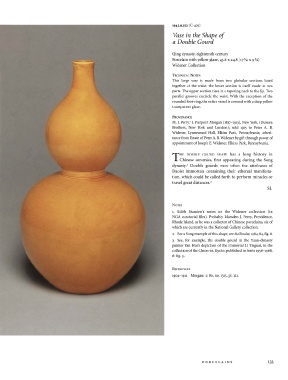
1942-9-552 (C-405)
                                                                          Vase  in  the  Shape  of
                                                                          a Double Gourd

                                                                          Qing dynasty,  eighteenth century
                                                                                                        3
                                                                                                              3
                                                                          Porcelain  with yellow  glaze, 43.6 x 24.8  (i/ /i6 x 9 /4)
                                                                          Widener Collection
                                                                          TECHNICAL NOTES
                                                                          This  large  vase  is  made  from  two  globular  sections  luted
                                                                          together  at  the  waist;  the  lower  section  is itself  made  in  two
                                                                          parts. The upper section rises in a tapering neck to the lip. Two
                                                                          parallel  grooves encircle  the  waist. With  the  exception  of  the
                                                                          rounded foot-ring, the entire vessel is covered with a deep yellow
                                                                          transparent glaze.

                                                                          PROVENANCE
                                                                                 1
                                                                          M. J. Perry.  J. Pierpont  Morgan  [1837-1913],  New York. (Duveen
                                                                          Brothers,  New  York  and  London);  sold  1915  to  Peter  A.  B.
                                                                          Widener,  Lynnewood  Hall,  Elkins  Park,  Pennsylvania;  inheri-
                                                                          tance from Estate of Peter A. B. Widener by gift through  power of
                                                                          appointment  of Joseph E. Widener, Elkins Park,  Pennsylvania.

                                                                             HE  DOUBLE  GOURD  SHAPE  has  a  long  history  in
                                                                         TChinese   ceramics,  first  appearing  during  the  Song
                                                                          dynasty. 2  Double  gourds  were  often  the  attributes  of
                                                                          Daoist  immortals  containing  their  ethereal  manifesta-
                                                                          tion, which could be called forth to perform  miracles or
                                                                          travel great distances. 3
                                                                                                                  SL


                                                                          NOTES
                                                                          1.  Edith  Standen's  notes  on  the  Widener  collection  (in
                                                                          NGA  curatorial  files).  Probably  Marsden  J. Perry,  Providence,
                                                                          Rhode Island, as he was a collector  of Chinese porcelains,  six of
                                                                          which are currently in the National Gallery collection.
                                                                          2.  For a Song example of this shape, see du Boulay 1984,84, fig. 8.
                                                                          3.  See,  for  example,  the  double  gourd  in  the  Yuan-dynasty
                                                                          painter  Yan Hui's  depiction  of the  immortal Li Tieguai,  in  the
                                                                          collection  of the Chion-in, Kyoto; published  in Siren 1956-1968,
                                                                          6: fig.  9.


                                                                          REFERENCES
                                                                          1904-1911  Morgan: 2: 80, no.  1315, pi. 121.


                                                                                                                  133
                                                                                      P O R C E L A I N S

