


Page 169 - Decorative Arts, Part II: Far Eastern Ceramics and Paintings, Persian and Indian Rugs and Carpets
P. 169
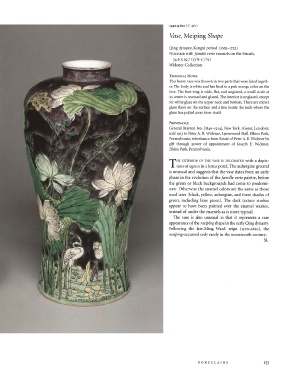
1942.9-610 (C-46i)
                                                                                 Meiping    Shape
                                                                           Vase y

                                                                           Qing dynasty,  Kangxi period (1662-1722)
                                                                           Porcelain with famille  verte enamels on the biscuit,
                                                                                      5
                                                                                          3
                                                                            34.6x19.7 (i3 /8X7 /4)
                                                                          Widener Collection
                                                                          TECHNICAL  NOTES
                                                                          This heavy vase was thrown  in two parts that were luted togeth-
                                                                          er. The body is white and has fired to a pale orange color on the
                                                                           foot. The foot-ring  is wide, flat, and  unglazed; a small circle at
                                                                          its center is recessed and glazed. The interior is unglazed, except
                                                                          for white glaze on the upper neck and bottom. There are minor
                                                                          glaze flaws on the surface and  a line  inside  the neck where  the
                                                                          glaze has pulled  away from  itself.

                                                                          PROVENANCE
                                                                          General Brayton  Ives  [1840-1914],  New York. (Gorer, London);
                                                                          sold  1913  to  Peter A. B. Widener,  Lynnewood Hall, Elkins Park,
                                                                          Pennsylvania; inheritance from  Estate of Peter A. B. Widener  by
                                                                          gift  through  power  of  appointment  of  Joseph  E.  Widener,
                                                                          Elkins Park, Pennsylvania.

                                                                              HE  EXTERIOR  OF THE VASE  IS DECORATED with  a  depic-
                                                                          Ttion of egrets in a lotus pond. The aubergine ground
                                                                          is unusual and  suggests that the vase dates from an early
                                                                          phase  in the  evolution  of the famille  verte palette, before
                                                                          the  green  or  black backgrounds  had  come  to  predomi-
                                                                          nate. Otherwise  the enamel colors are the  same as those
                                                                          used  later  (black, yellow, aubergine,  and  three  shades  of
                                                                          green,  including  lime  green). The  dark  texture  strokes
                                                                          appear  to  have  been  painted  over  the  enamel  washes,
                                                                          instead  of under the  enamels  as is more typical.
                                                                            The  vase  is  also  unusual  in  that  it  represents  a  rare
                                                                          appearance of the meiping shape in the early Qing dynasty.
                                                                          Following  the  late-Ming  Wanli  reign  (1570-1620),  the
                                                                          meiping occurred only rarely in the seventeenth  century.
                                                                                                                   SL


                                                                                       P O R C E L A I N S         153

