


Page 136 - Sotheby's Arts of Asia Paris, June 16, 2022
P. 136
143
               PROPERTY FROM A FRENCH PRIVATE COLLECTION  清康熙 十七至十八世紀 鎏金銅阿彌陀佛立像
               A GILT-BRONZE FIGURE OF AMITABHA          來源 :
               BUDDHA                                    現藏家之父母於約1980年得
               QING DYNASTY, KANGXI PERIOD, 17TH-18TH    後家族流傳至今
               CENTURY
               H. 53 cm, 20⅞ in.
               PROVENANCE
               Acquired by the parents of the present owner during the
               1980s and thence by family descent.
               Statue du Bouddha Amitabha en bronze doré, dynastie Qing,
               époque Kangxi, XVIIe-XVIIIe siècle
               40 000-60 000€


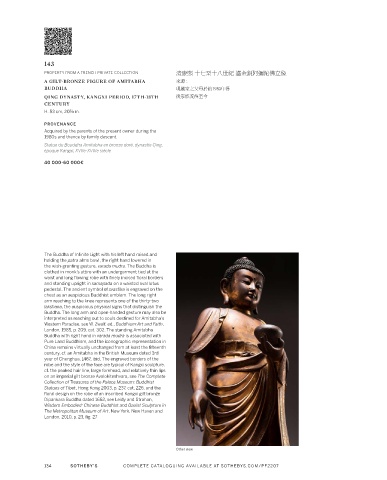
               The Buddha of Infinite Light with his left hand raised and
               holding the patra alms bowl, the right hand lowered in
               the wish-granting gesture, varada mudra. The Buddha is
               clothed in monk’s attire with an undergarment tied at the
               waist and long flowing robe with finely incised floral borders
               and standing upright in samapada on a waisted oval lotus
               pedestal. The ancient symbol of svastika is engraved on the
               chest as an auspicious Buddhist emblem. The long right
               arm reaching to the knee represents one of the thirty-two
               lakshana, the auspicious physical signs that distinguish the
               Buddha. The long arm and open-handed gesture may also be
               interpreted as reaching out to souls destined for Amitabha’s
               Western Paradise, see W. Zwalf, ed., Buddhism:Art and Faith,
               London, 1985, p. 209, cat. 302. The standing Amitabha
               Buddha with right hand in varada mudra is associated with
               Pure Land Buddhism, and the iconographic representation in
               China remains virtually unchanged from at least the fifteenth
               century, cf. an Amitabha in the British Museum dated 3rd
               year of Chenghua, 1467, ibid. The engraved borders of the
               robe and the style of the face are typical of Kangxi sculpture,
               cf. the peaked hair line, large forehead, and relatively thin lips
               on an imperial gilt bronze Avalokiteshvara, see The Complete
               Collection of Treasures of the Palace Museum: Buddhist
               Statues of Tibet, Hong Kong 2003, p. 237, cat. 226, and the
               floral design on the robe of an inscribed Kangxi gilt bronze
               Dipankara Buddha dated 1662, see Leidy and Strahan,
               Wisdom Embodied: Chinese Buddhist and Daoist Sculpture in
               The Metropolitan Museum of Art, New York, New Haven and
               London, 2010, p. 23, fig. 27


                                                         Other view

               134     SOTHEBY’S        COMPLETE CATALOGUING AVAILABLE AT SOTHEBYS.COM/PF2207

