


Page 92 - Sotheby's May 14, 2019 Fine Japanese Art. London
P. 92
RE-INVENTING LACQUER ART IN MODERN JAPAN


           Appointed as Teishitsu gigein [Imperial   century, demand for these accessories was   ceramic craftsmen and exhibit at interna-
           Household Artist] in 1902 (Meiji 35),   decreasing, and the new government of   tional fairs. In 1890, he received a silver
           Shirayama Shosai (1853-1923) was one of   Meiji would issue the Sword Abolishment   medal at the Universal Exposition in Paris
           the most celebrated artists of his time.   Edict (Haitorei) shortly thereafter in 1876.   and was appointed as professor at the Tokyo
           With contemporaries of him that included   Consequently, Shosai quickly shifted his   Art School (Tokyo bijutsu gakko).
           Shiata Zeshin and Ikeda Taishin, Shosai   career to lacquer at the age of seventeen   The rarity and quality of Shosai’s works
           co-founded the Japan Lacquer Society   and received a nine-year training in the   was the result of his perfection and deter-
           (Nihon shikkokai) in 1890 and contrib-  maki-e technique under Kobayashi Kozan.  mined dedication of only using tools and
           uted to the foundation of the Lacquer   At the age of twenty-seven, Shosai   materials of the highest standard that often
           Department of the Tokyo Art School   joined the Kiritsu Trading Company (Kiritsu   times resulted in extravagant production
           (Tokyo bijutsugakko) with the aim to   kosho kaisha), which had been established   cost. Within Japan, the official respect
           both preserve and modernise traditional   shortly after the 1873 Vienna World Fair due   for Shosai and his works long transcend-
           Japanese aesthetics.             to the rising demand for Japanese art in the   ed his death. For instance, The Emperor
             As for all artists of that time, Shosai’s   Western art market that also resulted in the   Shows (Hirohito) presented a lacquer box
           artistic career was profoundly affected by   emergence of Japonisme. As a commercial   by Shosai to Queen Elizabeth II on her
           the political circumstances in Japan in   enterprise, the company employed artisans   Coronation on 2 June 1953. Today, Shosai’s
           the wake of westernisation. In 1865, at the   in all branches of the decorative arts to   works are housed in the Bauer Collection,
           age of twelve, Shosai started his career as   cooperatively produce high-quality products   Royal Collection Trust (RCIN 39503),
           an apprentice in a workshop for sword   for the Western market. The company gave   Museum of Fine Arts, Boston (11.10305a-b)
           accessories. However, due to the fall of   him the opportunity to work with leading   and Rijksmuseum (AK-RAK-2015-4) outside
           the Tokugawa shogunate in the mid-19 th   painters, woodcarvers, metal workers and   of Japan.


           112
           AN IMPORTANT SUZURIBAKO          a fundame ground with numerous different
           [WRITING BOX]                    chrysanthemum flowers and leaves, almost
                                            all an indivdual design the interior fitted as
           SIGNED SHOSAI, MEIJI PERIOD,
           EARLY 20 TH  CENTURY             a writing box with inner frame supporting
                                            a slate, all on a ground of scrolling design
           菊文蒔絵硯箱、銘 白山松哉、明治時代、20            waves in gold hiramaki-e and nashiji, fitted
           世紀初期                             inner and outer wood boxes, tomobako
                                            signed and sealed shosai
           the retangular writing box with flush fitting   23 cm., 9⅛ in.
           cover and peuter rims decorated in gold,
           silver, black and red hiramaki-e, takamaki-e,   ‡ £ 150,000-180,000
           kinpun, hirame, kirikane gold and silver foil on   € 177,000-212,000   US$ 199,000-238,000


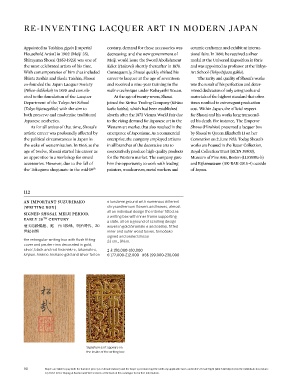
                                    Signature as it appears on
                                    the inside of the writing box


           90      Buyers are liable to pay both the hammer price (as estimated above) and the buyer’s premium together with any applicable taxes and Artist’s Resale Right (which will depend on the individual circumstanc-
                   es). Refer to the Buying at Auction and VAT sections at the back of this catalogue for further information.

