


Page 27 - Chow LIfe - Spring 2020
P. 27
Understanding Breeds as Populations


                                           Jerold S. Bell DVM jerold.bell@tufts.edu
                                   Cummings School of Veterinary Medicine at Tufts University

          Dog breeds are like different ethnic populations     that embody and produce health and quality
          of people. All people on earth are humans            were considered superior to the standard and
          (Homo sapiens), but we are not all closely           their offspring were used more frequently. Their
          related. Ethnic populations originally arose due     genes were retained and propagated in the
          to geographic isolation. There are some mutated  breed gene pool. Dogs that produced offspring
          genes (and hereditary diseases) that are shared      that were unhealthy or inferior to a standard
          by different ethnic populations. These mutations  were not used. Their influence and that of their
          occurred a long time ago in distant ancestors        ancestors was diminished.
          that preceded population migrations and the
          separation of ethnic populations. In some ethnic
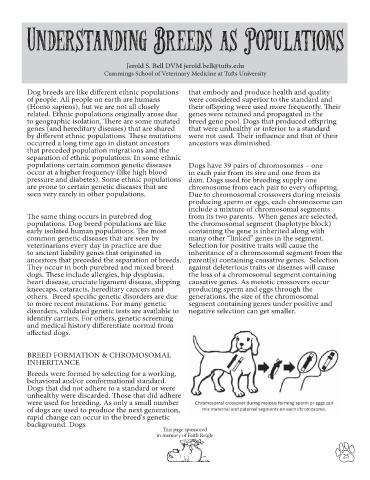
          populations certain common genetic diseases          Dogs have 39 pairs of chromosomes – one
          occur at a higher frequency (like high blood         in each pair from its sire and one from its
          pressure and diabetes). Some ethnic populations  dam. Dogs used for breeding supply one
          are prone to certain genetic diseases that are       chromosome from each pair to every offspring.
          seen very rarely in other populations.               Due to chromosomal crossovers during meiosis
                                                               producing sperm or eggs, each chromosome can
                                                               include a mixture of chromosomal segments
          The same thing occurs in purebred dog                from its two parents.  When genes are selected,
          populations. Dog breed populations are like          the chromosomal segment (haplotype block)
          early isolated human populations. The most           containing the gene is inherited along with
          common genetic diseases that are seen by             many other “linked” genes in the segment.
          veterinarians every day in practice are due          Selection for positive traits will cause the
          to ancient liability genes that originated in        inheritance of a chromosomal segment from the
          ancestors that preceded the separation of breeds.  parent(s) containing causative genes.  Selection
          They occur in both purebred and mixed breed          against deleterious traits or diseases will cause
          dogs. These include allergies, hip dysplasia,        the loss of a chromosomal segment containing
          heart disease, cruciate ligament disease, slipping  causative genes. As meiotic crossovers occur
          kneecaps, cataracts, hereditary cancers and          producing sperm and eggs through the
          others.  Breed specific genetic disorders are due    generations, the size of the chromosomal
          to more recent mutations. For many genetic           segment containing genes under positive and
          disorders, validated genetic tests are available to   negative selection can get smaller.
          identify carriers. For others, genetic screening
          and medical history differentiate normal from
          affected dogs.


          BREED FORMATION & CHROMOSOMAL
          INHERITANCE
          Breeds were formed by selecting for a working,
          behavioral and/or conformational standard.
          Dogs that did not adhere to a standard or were
          unhealthy were discarded. Those that did adhere
          were used for breeding. As only a small number
          of dogs are used to produce the next generation,
          rapid change can occur in the breed's genetic
          background. Dogs
                                                       This page sponsored
                                                     in memory of Faith Reigle


                                                                                                                  25

