


Page 50 - Chow LIfe - Spring 2021
P. 50
Heartworm Disease

                                                    Information for Dog Owners


                                              Key Facts


                       Heartworm disease is caused by Dirofilaria immitis (a parasitic worm) that is spread by
                       mosquitoes.
                          Signs of disease can be:

                          • Subclinical, i.e. no obvious signs.
                          • Slowly progressive. Dogs may develop cough, weakness and exercise intolerance.

                          • Severe. Dogs can have signs of congestive heart failure (cough, severe difficulty breathing,
                          fluid accumulation in abdomen), kidney or liver disease, fever, or coughing up blood.

                       Optimal therapy for adult heartworm infection involves pre-treatment for microfilaria (young
                       heartworms) and suspect Wolbachia bacteria, followed by adulticide therapy (elimination of
                       adult heartworms).
                       Heartworm is found globally.

                       Regular use of heartworm preventive medication is critical to prevent the disease


          What is it?                                          Who gets it?
          Canine heartworm disease is caused by Dirofilaria    Dogs and other canid species can be infected, along
          immitis, a nematode (worm) transmitted by mos-       with cats and ferrets. Heartworm disease is common
          quitoes. During the early phases of heartworm        in dogs in the southeastern United States.
          infection, most dogs will not show signs of disease.
          Later in the disease course, blood flow carries the   However, heartworms can be found in other parts of
          heartworms into the lung arteries. This can cause    the United States or Canada where temperatures rise
          thromboembolism (blood clots), allergic pneumo-      above 57°F (14°C), especially after movement of in-
          nitis (lung inflammation), and right-sided heart     fected dogs to northern regions, e.g. after Hurricane
          failure. Larger numbers of adult worms result in     Katrina in 2005.
          worse disease.
                                                               Can people get sick with it?
          Wolbachia (a bacterium carried within the heart-     It is extremely rare for humans to be infected with
          worm) released from dying adult heartworms is        D. immitis. Spread is from mosquitoes, not directly
          thought to worsen inflammation and predispose to     from dogs.
          shock (inadequate blood flow to the body, resulting
          in organ damage).                                    How is it spread?
                                                               (Transmission & Infection risk)
                                                               Heartworms are spread via mosquitoes. More than
                                                               70 species of mosquitoes are capable of transmitting
                                                               heartworm.
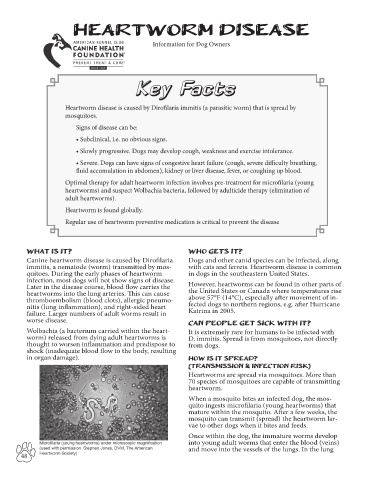
                                                               When a mosquito bites an infected dog, the mos-
                                                               quito ingests microfilaria (young heartworms) that
                                                               mature within the mosquito. After a few weeks, the
                                                               mosquito can transmit (spread) the heartworm lar-
                                                               vae to other dogs when it bites and feeds.
                                                               Once within the dog, the immature worms develop
                                                               into young adult worms that enter the blood (veins)
                                                               and move into the vessels of the lungs. In the lung
        48

