


Page 51 - Chow LIfe - Spring 2021
P. 51
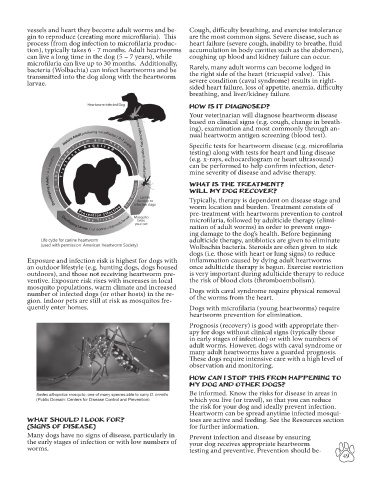
vessels and heart they become adult worms and be-     Cough, difficulty breathing, and exercise intolerance
          gin to reproduce (creating more microfilaria).  This   are the most common signs. Severe disease, such as
          process (from dog infection to microfilaria produc-   heart failure (severe cough, inability to breathe, fluid
          tion), typically takes 6 - 7 months. Adult heartworms  accumulation in body cavities such as the abdomen),
          can live a long time in the dog (5 – 7 years), while   coughing up blood and kidney failure can occur.
          microfilaria can live up to 30 months.  Additionally,
          bacteria (Wolbachia) can infect heartworms and be     Rarely, many adult worms can become lodged in
          transmitted into the dog along with the heartworm     the right side of the heart (tricuspid valve).  This
          larvae.                                               severe condition (caval syndrome) results in right-
                                                                sided heart failure, loss of appetite, anemia, difficulty
                                                                breathing, and liver/kidney failure.

                                                                How is it diagnosed?
                                                                Your veterinarian will diagnose heartworm disease
                                                                based on clinical signs (e.g. cough, change in breath-
                                                                ing), examination and most commonly through an-
                                                                nual heartworm antigen screening (blood test).
                                                                Specific tests for heartworm disease (e.g. microfilaria
                                                                testing) along with tests for heart and lung disease
                                                                (e.g. x-rays, echocardiogram or heart ultrasound)
                                                                can be performed to help confirm infection, deter-
                                                                mine severity of disease and advise therapy.

                                                                What is the treatment?
                                                                Will my dog recover?
                                                                Typically, therapy is dependent on disease stage and
                                                                worm location and burden. Treatment consists of
                                                                pre-treatment with heartworm prevention to control
                                                                microfilaria, followed by adulticide therapy (elimi-
                                                                nation of adult worms) in order to prevent ongo-
                                                                ing damage to the dog’s health. Before beginning
                                                                adulticide therapy, antibiotics are given to eliminate
                                                                Wolbachia bacteria. Steroids are often given to sick
                                                                dogs (i.e. those with heart or lung signs) to reduce
          Exposure and infection risk is highest for dogs with   inflammation caused by dying adult heartworms
          an outdoor lifestyle (e.g. hunting dogs, dogs housed   once adulticide therapy is begun. Exercise restriction
          outdoors), and those not receiving heartworm pre-     is very important during adulticide therapy to reduce
          ventive. Exposure risk rises with increases in local   the risk of blood clots (thromboembolism).
          mosquito populations, warm climate and increased
          number of infected dogs (or other hosts) in the re-   Dogs with caval syndrome require physical removal
          gion. Indoor pets are still at risk as mosquitos fre-  of the worms from the heart.
          quently enter homes.                                  Dogs with microfilaria (young heartworms) require
                                                                heartworm prevention for elimination.
                                                                Prognosis (recovery) is good with appropriate ther-
                                                                apy for dogs without clinical signs (typically those
                                                                in early stages of infection) or with low numbers of
                                                                adult worms. However, dogs with caval syndrome or
                                                                many adult heartworms have a guarded prognosis.
                                                                These dogs require intensive care with a high level of
                                                                observation and monitoring.

                                                                How can I stop this from happening to
                                                                my dog and other dogs?
                                                                Be informed. Know the risks for disease in areas in
                                                                which you live (or travel), so that you can reduce
                                                                the risk for your dog and ideally prevent infection.
                                                                Heartworm can be spread anytime infected mosqui-
          What should I look for?                               toes are active and feeding. See the Resources section
          (Signs of disease)                                    for further information.
          Many dogs have no signs of disease, particularly in   Prevent infection and disease by ensuring
          the early stages of infection or with low numbers of   your dog receives appropriate heartworm
          worms.                                                testing and preventive. Prevention should be-
                                                                                                                  49

