


Page 86 - EW February 2026
P. 86
Books


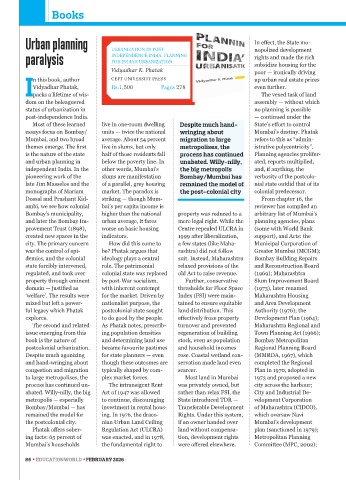
         Urban planning              URBANIZATION IN POST-                         In effect, the State mo-
                                                                                   nopolized development
         paralysis                   INDEPENDENCE INDIA: PLANNING                  rights and made the rich
                                     FOR INDIA'S URBANIZATION
                                     Vidyadhar K. Phatak                           subsidize housing for the
                                                                                   poor — ironically driving
            n this book, author      CEPT UNIVERSITY PRESS                         up urban real estate prices
            Vidyadhar Phatak,        Rs.1,500                  Pages 278           even further.
         Ipacks a lifetime of wis-                                                   The vexed task of land
         dom on the beleaguered                                                    assembly — without which
         status of urbanization in                                                 no planning is possible
         post-independence India.                                                  — continued under the
            Most of these learned   live in one-room dwelling   Despite much hand-  State’s effort to control
         essays focus on Bombay/  units — twice the national   wringing about      Mumbai’s destiny. Phatak
         Mumbai, and two broad    average. About 54 percent   migration to large   refers to this as “admin-
         themes emerge. The first   live in slums, but only   metropolises, the    istrative polycentricity”.
         is the nature of the state   half of those residents fall   process has continued   Planning agencies prolifer-
         and urban planning in    below the poverty line. In   unabated. Willy-nilly,   ated, reports multiplied,
         independent India. In the   other words, Mumbai’s   the big metropolis    and, if anything, the
         pioneering work of the   slums are manifestation   Bombay/Mumbai has      verbosity of the postcolo-
         late Jim Masselos and the   of a parallel, grey housing   remained the model of   nial state outdid that of its
         monographs of Mariam     market. The paradox is   the post-colonial city  colonial predecessor.
         Dossal and Prashant Kid-  striking — though Mum-                            From chapter 16, the
         ambi, we see how colonial   bai’s per capita income is                    reviewer has compiled an
         Bombay’s municipality,   higher than the national   property was reduced to a   arbitrary list of Mumbai’s
         and later the Bombay Im-  urban average, it fares   mere legal right. While the   planning agencies, plans
         provement Trust (1898),   worse on basic housing   Centre repealed ULCRA in   (some with World Bank
         created new spaces in the   indicators.           1999 after liberalization,   support), and Acts: the
         city. The primary concern   How did this come to   a few states (like Maha-  Municipal Corporation of
         was the control of epi-  be? Phatak argues that   rashtra) did not follow   Greater Mumbai (MCGM);
         demics, and the colonial   ideology plays a central   suit. Instead, Maharashtra   Bombay Building Repairs
         state forcibly intervened,   role. The patrimonial   relaxed provisions of the   and Reconstruction Board
         regulated, and took over   colonial state was replaced   old Act to raise revenue.  (1969); Maharashtra
         property through eminent   by post-War socialism,   Further, conservative   Slum Improvement Board
         domain — justified as    with inherent contempt   thresholds for Floor Space   (1973), later renamed
         ‘welfare’. The results were   for the market. Driven by    Index (FSI) were main-  Maharashtra Housing
         mixed but left a power-  nationalist purpose, the   tained to ensure equitable   and Area Development
         ful legacy which Phatak   postcolonial state sought   land distribution. This   Authority (1976); the
         explores.                to do good by the people.   effectively froze property   Development Plan (1964);
            The second and related   As Phatak notes, prescrib-  turnover and prevented   Maharashtra Regional and
         issue emerging from this   ing population densities   regeneration of building   Town Planning Act (1966);
         book is the nature of    and determining land use   stock, even as population   Bombay Metropolitan
         postcolonial urbanization.   became favourite pastimes   and household incomes   Regional Planning Board
         Despite much agonizing   for state planners — even   rose. Coastal wetland con-  (MMRDA, 1967), which
         and hand-wringing about   though these outcomes are   servation made land even   completed the Regional
         congestion and migration   typically shaped by com-  scarcer.             Plan in 1970, adopted in
         to large metropolises, the   plex market forces.    Most land in Mumbai   1973 and proposed a new
         process has continued un-  The intransigent Rent   was privately owned, but   city across the harbour;
         abated. Willy-nilly, the big   Act of 1947 was allowed   rather than relax FSI, the   City and Industrial De-
         metropolis — especially   to continue, discouraging   State introduced TDR —   velopment Corporation
         Bombay/Mumbai — has      investment in rental hous-  Transferable Development   of Maharashtra (CIDCO),
         remained the model for   ing. In 1976, the draco-  Rights. Under this system,   which oversaw Navi
         the postcolonial city.   nian Urban Land Ceiling   if an owner handed over   Mumbai’s development
            Phatak offers sober-  Regulation Act (ULCRA)   land without compensa-  plan (sanctioned in 1979);
         ing facts: 65 percent of   was enacted, and in 1978,   tion, development rights   Metropolitan Planning
         Mumbai’s households      the fundamental right to   were offered elsewhere.   Committee (MPC, 2002);

         86    EDUCATIONWORLD   FEBRUARY 2026

