


Page 43 - EW August 2025
P. 43
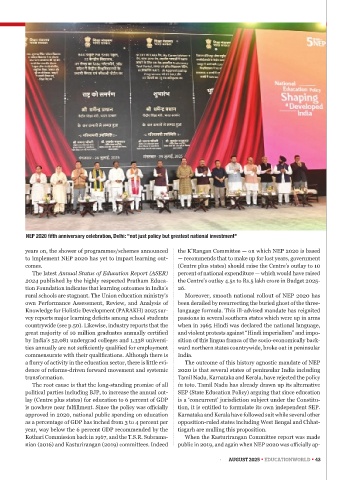
NEP 2020 fifth anniversary celebration, Delhi: "not just policy but greatest national investment"

         years on, the shower of programmes/schemes announced   the K’Rangan Committee — on which NEP 2020 is based
         to implement NEP 2020 has yet to impact learning out-  — recommends that to make up for lost years, government
         comes.                                           (Centre plus states) should raise the Centre’s outlay to 10
           The latest Annual Status of Education Report (ASER)   percent of national expenditure — which would have raised
         2024 published by the highly respected Pratham Educa-  the Centre’s outlay 4.5x to Rs.5 lakh crore in Budget 2025-
         tion Foundation indicates that learning outcomes in India’s   26.
         rural schools are stagnant. The Union education ministry’s   Moreover, smooth national rollout of NEP 2020 has
         own Performance Assessment, Review, and Analysis of   been derailed by resurrecting the buried ghost of the three-
         Knowledge for Holistic Development (PARAKH) 2025 sur-  language formula. This ill-advised mandate has reignited
         vey reports major learning deficits among school students   passions in several southern states which were up in arms
         countrywide (see p.50). Likewise, industry reports that the   when in 1965 Hindi was declared the national language,
         great majority of 10 million graduates annually certified   and violent protests against “Hindi imperialism” and impo-
         by India’s 52,081 undergrad colleges and 1,338 universi-  sition of this lingua franca of the socio-economically back-
         ties annually are not sufficiently qualified for employment   ward northern states countrywide, broke out in peninsular
         commensurate with their qualifications. Although there is   India.
         a flurry of activity in the education sector, there is little evi-  The outcome of this history agnostic mandate of NEP
         dence of reforms-driven forward movement and systemic   2020 is that several states of peninsular India including
         transformation.                                  Tamil Nadu, Karnataka and Kerala, have rejected the policy
           The root cause is that the long-standing promise of all   in toto. Tamil Nadu has already drawn up its alternative
         political parties including BJP, to increase the annual out-  SEP (State Education Policy) arguing that since education
         lay (Centre plus states) for education to 6 percent of GDP   is a ‘concurrent’ jurisdiction subject under the Constitu-
         is nowhere near fulfillment. Since the policy was officially   tion, it is entitled to formulate its own independent SEP.
         approved in 2020, national public spending on education   Karnataka and Kerala have followed suit while several other
         as a percentage of GDP has inched from 3 to 4 percent per   opposition-ruled states including West Bengal and Chhat-
         year, way below the 6 percent GDP recommended by the   tisgarh are mulling this proposition.
         Kothari Commission back in 1967, and the T.S.R. Subrama-  When the Kasturirangan Committee report was made
         nian (2016) and Kasturirangan (2019) committees. Indeed   public in 2019, and again when NEP 2020 was officially ap-

                                                                           AUGUST 2025    EDUCATIONWORLD   43

