


Page 48 - EW August 2025
P. 48
Cover Story


         66 percent cannot identify 1-9 numerals. Ditto the widely   University and IIT-Delhi, former education specialist at the
         welcomed first-ever National Curriculum Framework for   World Bank, former professor and founder-director of the
         Foundational Stage (NCF-FS) 2022 has not taken off be-  Centre for Early Childhood Education and Development at
         cause of lack of trained teachers to deliver ECCE in AWCs.  Ambedkar University, Delhi.
           A positive fallout of NEP 2020 mandating compulsory   Five years on, fulfilling NEP 2020’s mandate to univer-
         ECCE for all children in the 3-6 age group is that several   salise ECCE by 2030 requires the grand Saksham Anganwa-
         state governments countrywide have added pre-primary/  di and NIPUN Bharat Mission to be matched with substan-
         kindergarten sections in government primary schools, for-  tially larger budgetary outlays. The Union Budget 2025-26
         mally integrating ECCE in the school education system. This   allocations of Rs.26,889 crore to the ICDS programme and
         will increase the number of public preschools significantly.  Rs.2,700 crore for NIPUN Bharat are grossly inadequate to
           Yet the biggest stumbling block to realisation of NEP   upgrade the country’s 1.39 million anganwadis and “build a
         2020’s mandate to                                cadre of high-quality ECCE teachers” to deliver professional
         universalise ECCE is                             ECCE. Five years on, government’s failure to match policy
         that the ICDS/NIPUN                              intent with financial commitment to ECCE — a neglected
         Bharat schemes have                              area for over seven decades that is belatedly accorded high
         not been followed with                           importance by NEP 2020 — will have a domino effect and
         sufficient   budgetary                           undermine learning outcomes in primary-secondary and
         allocation. The Cen-                             higher education in the years ahead.
         tral government’s al-
         location for  the  ICDS
         programme for the                                 Primary-Secondary
         country’s 1.39 million
         anganwadis is a mere                                         Education
         Rs.26,889 crore in                Dr. Venita Kaul
         2025-26 — Rs.3,361 per
         child per year — grossly insufficient to provide adequate
         nutrition let alone professionally administered early child-
         hood education as envisaged by NEP 2020. Moreover no
         additional budgetary and policy provision has been made
         to train and upgrade the skills of the country’s 2.3 million
         anganwadi workers and helpers to enable them to deliver
         quality ECCE — an essential mandate of NEP 2020. The
         overwhelming majority of the country’s 2.3 million an-
         ganwadi workers are class X/XII graduates with minimal
         teacher training in ECCE and are paid a pittance (Rs.8,000-
         12,000 per month).
           “The high importance accorded to ECCE in NEP 2020 has
         given the sector national visibility and created awareness
         and discourse about the critical role of foundational stage
         education. The government has also done well to quickly
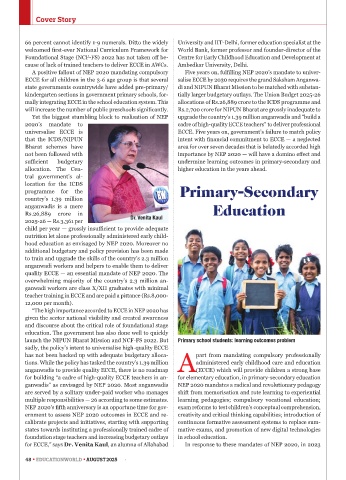
         launch the NIPUN Bharat Mission and NCF-FS 2022. But   Primary school students: learning outcomes problem
         sadly, the policy’s intent to universalise high-quality ECCE
         has not been backed up with adequate budgetary alloca-  part from mandating compulsory professionally
         tions. While the policy has tasked the country’s 1.39 million   administered early childhood care and education
         anganwadis to provide quality ECCE, there is no roadmap   A(ECCE) which will provide children a strong base
         for building “a cadre of high-quality ECCE teachers in an-  for elementary education, in primary-secondary education
         ganwadis” as envisaged by NEP 2020. Most anganwadis   NEP 2020 mandates a radical and revolutionary pedagogy
         are served by a solitary under-paid worker who manages   shift from memorisation and rote learning to experiential
         multiple responsibilities — 26 according to some estimates.   learning pedagogies; compulsory vocational education;
         NEP 2020’s fifth anniversary is an opportune time for gov-  exam reforms to test children’s conceptual comprehension,
         ernment to assess NEP 2020 outcomes in ECCE and re-  creativity and critical thinking capabilities; introduction of
         calibrate projects and initiatives, starting with supporting   continuous formative assessment systems to replace sum-
         states towards instituting a professionally trained cadre of   mative exams, and promotion of new digital technologies
         foundation stage teachers and increasing budgetary outlays   in school education.
         for ECCE,” says Dr. Venita Kaul, an alumna of Allahabad   In response to these mandates of NEP 2020, in 2023

         48    EDUCATIONWORLD   AUGUST 2025

