


Page 53 - EW August 2025
P. 53
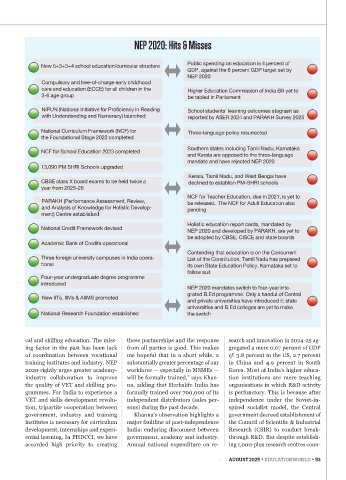
NEP 2020: Hits & Misses


              New 5+3+3+4 school  education/curricular structure  Public spending on education is 4 percent of
                                                             GDP, against the 6 percent GDP target set by
                                                             NEP 2020
              Compulsory and free-of-charge early childhood
              care and education (ECCE) for all children in the   Higher Education Commission of India Bill yet to
              3-6 age group                                   be tabled in Parliament
              NIPUN (National Initiative for Proficiency in Reading   School students' learning outcomes stagnant as
              with Understanding and Numeracy) launched       reported by ASER 2024 and PARAKH Survey 2025

              National Curriculum Framework (NCF) for         Three-language policy resurrected
              the Foundational Stage 2022 completed
                                                             Southern states including Tamil Nadu, Karnataka
              NCF for School Education 2023 completed
                                                             and Kerala are opposed to the three-language
                                                             mandate and have rejected NEP 2020
              13,090 PM SHRI Schools upgraded
                                                              Kerala, Tamil Nadu, and West Bengal have
              CBSE class X board exams to be held twice a     declined to establish PM-SHRI schools
              year from 2025-26
                                                             NCF for Teacher Education, due in 2021, is yet to
              PARAKH (Performance Assessment, Review,        be released.  The NCF for Adult Education also
              and Analysis of Knowledge for Holistic Develop-  pending
              ment) Centre established
                                                             Holistic education report cards, mandated by
              National Credit Framework devised              NEP 2020 and developed by PARAKH, are yet to
                                                             be adopted by CBSE, CISCE and state boards
              Academic Bank of Credits operational
                                                             Contending that education is on the Concurrent
              Three foreign university campuses in India opera-  List of the Constitution, Tamil Nadu has prepared
              tional                                         its own State Education Policy. Karnataka set to
                                                             follow suit
              Four-year undergraduate degree programme
              introduced
                                                             NEP 2020 mandates switch to four-year inte-
                                                             grated B.Ed programme. Only a handul of Central
               New IITs, IIMs & AIIMS promoted
                                                             and private universities have introduced it; state
                                                             universities and B.Ed colleges are yet to make
              National Research Foundation established       the switch


         cal and skilling education. The miss-  these partnerships and the response   search and innovation in 2024-25 ag-
         ing factor in the past has been lack   from all parties is good. This makes   gregated a mere 0.67 percent of GDP
         of coordination between vocational   me hopeful that in a short while, a   cf. 3.8 percent in the US, 2.7 percent
         training institutes and industry. NEP   substantially greater percentage of our   in China and  4.9 percent  in South
         2020 rightly urges greater academy-  workforce — especially in MSMEs —   Korea. Most of India’s higher educa-
         industry collaboration to improve   will be formally trained,” says Khan-  tion institutions are mere teaching
         the quality of VET and skilling pro-  na, adding that Herbalife India has   organisations in which R&D activity
         grammes. For India to experience a   formally trained over 700,000 of its   is perfunctory. This is because after
         VET and skills development revolu-  independent distributors (sales per-  independence under  the  Soviet-in-
         tion, tripartite cooperation between   sons) during the past decade.        spired socialist model, the Central
         government, industry and training   Khanna’s observation highlights a   government decreed establishment of
         institutes is necessary for curriculum   major faultline of post-independence   the Council of Scientific & Industrial
         development, internships and experi-  India: enduring disconnect between   Research (CSIR) to conduct break-
         ential learning. In PHDCCI, we have   government, academy and industry.   through R&D. But despite establish-
         accorded high priority to creating   Annual national expenditure on re-  ing 1,000-plus research centres coun-

                                                                           AUGUST 2025    EDUCATIONWORLD   53

