


Page 203 - EW October 2025
P. 203
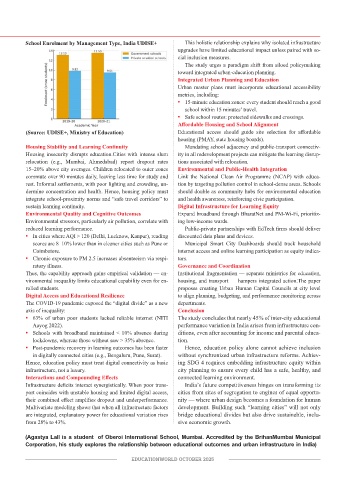
School Enrolment by Management Type, India UDISE+   This holistic relationship explains why isolated infrastructure
                                                          upgrades have limited educational impact unless paired with so-
                                                          cial inclusion measures.
                                                             The study urges a paradigm shift from siloed policymaking
                                                          toward integrated urban-education planning.
                                                          Integrated Urban Planning and Education
                                                          Urban master plans must incorporate educational accessibility
                                                          metrics, including:
                                                          •  15-minute education zones: every student should reach a good
                                                             school within 15 minutes’ travel.
                                                          •  Safe school routes: protected sidewalks and crossings.
                                                          Affordable Housing and School Alignment
         (Source: UDISE+, Ministry of Education)          Educational  access  should  guide  site  selection  for  affordable
                                                          housing (PMAY, state housing boards).
         Housing Stability and Learning Continuity           Mandating school adjacency and public-transport connectiv-
         Housing insecurity disrupts education.Cities with intense slum   ity in all redevelopment projects can mitigate the learning disrup-
         relocation (e.g., Mumbai,  Ahmedabad) report dropout rates   tions associated with relocation.
         15–20% above city averages. Children relocated to outer zones   Environmental and Public-Health Integration
         commute over 90 minutes daily, leaving less time for study and   Link the National Clean Air Programme (NCAP) with educa-
         rest. Informal settlements, with poor lighting and crowding, un-  tion by targeting pollution control in school-dense areas. Schools
         dermine concentration and health. Hence, housing policy must   should double as community hubs for environmental education
         integrate school-proximity norms and “safe travel corridors” to   and health awareness, reinforcing civic participation.
         sustain learning continuity.                     Digital Infrastructure for Learning Equity
         Environmental Quality and Cognitive Outcomes     Expand broadband through BharatNet and PM-Wi-Fi, prioritiz-
         Environmental stressors, particularly air pollution, correlate with   ing low-income wards.
         reduced learning performance.                       Public-private partnerships with EdTech firms should deliver
         •  In cities where AQI > 120 (Delhi, Lucknow, Kanpur), reading   discounted data plans and devices.
            scores are 8–10% lower than in cleaner cities such as Pune or   Municipal Smart City Dashboards should track household
            Coimbatore.                                   internet access and online learning participation as equity indica-
         •  Chronic exposure to PM 2.5 increases absenteeism via respi-  tors.
            ratory illness.                               Governance and Coordination
         Thus, the capability approach gains empirical validation — en-  Institutional fragmentation — separate ministries for education,
         vironmental inequality limits educational capability even for en-  housing, and transport — hampers integrated action.The paper
         rolled students.                                 proposes creating Urban Human Capital Councils at city level
         Digital Access and Educational Resilience        to align planning, budgeting, and performance monitoring across
         The COVID-19 pandemic exposed the “digital divide” as a new   departments.
         axis of inequality:                              Conclusion
         •  63% of urban poor students lacked reliable internet (NITI   The study concludes that nearly 45% of inter-city educational
            Aayog 2022).                                  performance variation in India arises from infrastructure con-
         •  Schools with broadband maintained < 10% absence during   ditions, even after accounting for income and parental educa-
            lockdowns, whereas those without saw > 35% absence.  tion.
         •  Post-pandemic recovery in learning outcomes has been faster   Hence, education policy alone cannot achieve inclusion
            in digitally connected cities (e.g., Bengaluru, Pune, Surat).  without synchronized urban infrastructure reforms. Achiev-
         Hence, education policy must treat digital connectivity as basic   ing SDG 4 requires embedding infrastructure equity within
         infrastructure, not a luxury.                    city planning to ensure every child has a safe, healthy, and
         Interactions and Compounding Effects             connected learning environment.
         Infrastructure deficits interact synergistically. When poor trans-  India’s future competitiveness hinges on transforming its
         port coincides with unstable housing and limited digital access,   cities from sites of segregation to engines of equal opportu-
         their combined effect amplifies dropout and underperformance.   nity — where urban design becomes a foundation for human
         Multivariate modeling shows that when all infrastructure factors   development. Building such “learning cities” will not only
         are integrated, explanatory power for educational variation rises   bridge educational divides but also drive sustainable, inclu-
         from 28% to 43%.                                 sive economic growth.

         (Agastya Lall is a student  of Oberoi International School, Mumbai. Accredited by the BrihanMumbai Municipal
         Corporation, his study explores the relationship between educational outcomes and urban infrastructure in India)

                                           EDUCATIONWORLD  OCTOBER  2025  OCTOBER 2025    EDUCATIONWORLD   203

