


Page 196 - EW October 2025
P. 196
Books


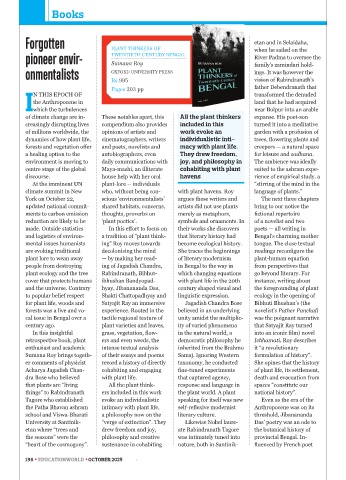
         Forgotten                   PLANT THINKERS OF                             etan and in Selaidaha,
                                                                                   when he sailed on the
         pioneer envir-              TWENTIETH CENTURY BENGAL                      River Padma to oversee the
                                     Sumana Roy
                                                                                   family’s zamindari hold-
         onmentalists                OXFORD UNIVERSITY PRESS                       ings. It was however the
                                                                                   vision of Rabindranath’s
                                     Rs.995
                                     Pages 203 pp                                  father Debendranath that
            N THIS EPOCH OF                                                        transformed the denuded
            the Anthropocene in                                                    land that he had acquired
         Iwhich the turbulences                                                    near Bolpur into an arable
         of climate change are in-  These notables apart, this   All the plant thinkers   expanse. His poet-son
         creasingly disrupting lives   compendium also provides   included in this   turned it into a meditative
         of millions worldwide, the   opinions of artists and   work evoke an      garden with a profusion of
         dynamics of how plant life,   cinematographers, writers   individualistic inti-  trees, flowering plants and
         forests and vegetation offer   and poets, novelists and   macy with plant life.   creepers — a natural space
         a healing option to the   autobiographers, even   They drew freedom,      for leisure and sadhana.
         environment is moving to   daily communications with   joy, and philosophy in   The ambience was ideally
         centre stage of the global   Maya-mashi, an illiterate   cohabiting with plant   suited to the ashram expe-
         discourse.               house help with her oral   havens                rience of empirical study, a
           At the imminent UN     plant-lore -- individuals                        “stirring of the mind in the
         climate summit in New    who, without being con-  with plant havens. Roy   language of plants.”
         York on October 22,      scious ‘environmentalists’   argues these writers and   The next three chapters
         updated national commit-  shared habitats, concerns,   artists did not use plants   bring to our notice the
         ments to carbon emission   thoughts, proverbs on   merely as metaphors,   fictional repertoire
         reduction are likely to be   ‘plant poetics’.    symbols and ornaments. In   of a novelist and two
         made. Outside statistics   In this effort to focus on   their works she discovers   poets — all writing in
         and logistics of environ-  a tradition of “plant think-  that literary history had   Bengal’s charming mother
         mental issues humanists   ing” Roy moves towards   become ecological history.   tongue. The close textual
         are evoking traditional   decolonising the mind   She traces the beginnings   readings reconfigure the
         plant lore to wean away   — by making her read-  of literary modernism    plant-human equation
         people from destroying   ing of Jagadish Chandra,   in Bengal to the way in   from perspectives that
         plant ecology and the tree   Rabindranath, Bibhut-  which changing equations   go beyond literary. For
         cover that protects humans   ibhushan Bandyopad-  with plant life in the 20th   instance, writing about
         and the universe. Contrary   hyay, Jibanananda Das,   century shaped visual and   the foregrounding of plant
         to popular belief respect   Shakti Chattopadhyay and   linguistic expression.  ecology in the opening of
         for plant life, woods and   Satyajit Ray an immersive   Jagadish Chandra Bose   Bibhuti Bhushan’s (the
         forests was a live and vo-  experience. Rooted in the   believed in an underlying   novelist’s Pather Panchali
         cal issue in Bengal over a   tactile regional texture of   unity amidst the multiplic-  was the poignant narrative
         century ago.             plant varieties and leaves,   ity of varied phenomena   that Satyajit Ray turned
           In this insightful     grass, vegetation, flow-  in the natural world, a   into an iconic film) novel
         retrospective book, plant   ers and even weeds, the   democratic philosophy he   Ichhamati, Roy describes
         enthusiast and academic   intense textual analysis   inherited from the Brahmo   it “a revolutionary
         Sumana Roy brings togeth-  of their essays and poems   Samaj. Ignoring Western   formulation of history”.
         er comments of physicist   record a history of directly   taxonomy, he conducted   She opines that the history
         Acharya Jagadish Chan-   cohabiting and engaging   fine-tuned experiments   of plant life, its settlement,
         dra Bose who believed    with plant life.        that captured agency,    death and evacuation from
         that plants are “living    All the plant think-  response and language in   spaces “constitute our
         things” to Rabindranath   ers included in this work   the plant world. A plant   national history”.
         Tagore who established   evoke an individualistic   speaking for itself was new   Even as the era of the
         the Patha Bhavan ashram   intimacy with plant life,   self-reflexive modernist   Anthropocene was on its
         school and Viswa-Bharati   a philosophy now on the   literary culture.    threshold, Jibanananda
         University at Santinik-  “verge of extinction”. They   Likewise Nobel laure-  Das’ poetry was an ode to
         etan where “trees and    drew freedom and joy,   ate Rabindranath Tagore   the botanical history of
         the seasons” were the    philosophy and creative   was intimately tuned into   provincial Bengal. In-
         “heart of the cosmogony”.   sustenance in cohabiting   nature, both in Santinik-  fluenced by French poet

         196    EDUCATIONWORLD   OCTOBER 2025

