


Page 198 - EW October 2025
P. 198
Books


         Baudelaire, he explored   foundational principles of
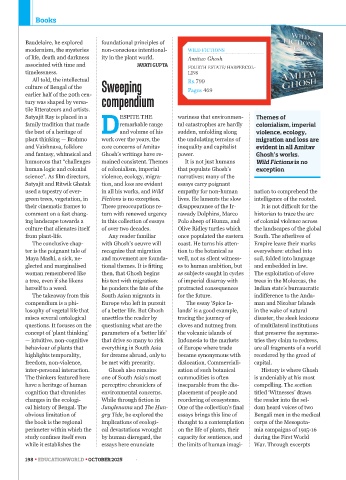
         modernism, the mysteries   non-conscious intentional-  WILD FICTIONS
         of life, death and darkness   ity in the plant world.  Amitav Ghosh
         associated with time and            JAYATI GUPTA     FOURTH ESTATE/ HARPERCOL-
         timelessness.                                        LINS
           All told, the intellectual                         Rs.799
         culture of Bengal of the   Sweeping                  Pages 469
         earlier half of the 20th cen-
         tury was shaped by versa-  compendium
         tile litterateurs and artists.
         Satyajit Ray is placed in a    ESPITE THE        wariness that environmen-  Themes of
         family tradition that made     remarkable range   tal catastrophes are hardly   colonialism, imperial
         the best of a heritage of   Dand volume of his   sudden, unfolding along   violence, ecology,
         plant thinking — Brahmo   work over the years, the   the undulating terrains of   migration and loss are
         and Vaishnava, folklore   core concerns of Amitav   inequality and capitalist   evident in all Amitav
         and fantasy, whimsical and   Ghosh’s writings have re-  power.             Ghosh’s works.
         humorous that “challenges   mained consistent. Themes   It is not just humans   Wild Fictions is no
         human logic and colonial   of colonialism, imperial   that populate Ghosh’s   exception
         science”. As film directors,   violence, ecology, migra-  narratives; many of the
         Satyajit and Ritwik Ghatak   tion, and loss are evident   essays carry poignant
         used a tapestry of ever-  in all his works, and Wild   empathy for non-human   nation to comprehend the
         green trees, vegetation, in   Fictions is no exception.   lives. He laments the slow   intelligence of the rooted.
         their cinematic frames to   These preoccupations re-  disappearance of the Ir-  It is not difficult for the
         comment on a fast chang-  turn with renewed urgency   rawady Dolphins, Marco   historian to trace the arc
         ing landscape towards a   in this collection of essays   Polo sheep of Hunza, and   of colonial violence across
         culture that alienates itself   of over two decades.  Olive Ridley turtles which   the landscapes of the global
         from plant-life.           Any reader familiar   once populated the eastern   South. The afterlives of
           The conclusive chap-   with Ghosh’s oeuvre will   coast. He turns his atten-  Empire leave their marks
         ter is the poignant tale of   recognize that migration   tion to the botanical as   everywhere: etched into
         Maya Mashi, a sick, ne-  and movement are founda-  well, not as silent witness-  soil, folded into language
         glected and marginalised   tional themes. It is fitting   es to human ambition, but   and embedded in law.
         woman remembered like    then, that Ghosh begins   as subjects caught in cycles   The exploitation of clove
         a tree, even if she likens   his text with migration:   of imperial disarray with   trees in the Moluccas, the
         herself to a weed.       he ponders the fate of the   protracted consequences   Indian state’s bureaucratic
           The takeaway from this   South Asian migrants in   for the future.      indifference to the Anda-
         compendium is a phi-     Europe who left in pursuit    The essay ‘Spice Is-  man and Nicobar Islands
         losophy of vegetal life that   of a better life. But Ghosh   lands’ is a good example,   in the wake of natural
         raises several ontological   unsettles the reader by   tracing the journey of   disaster, the sleek lexicons
         questions. It focuses on the   questioning what are the   cloves and nutmeg from   of multilateral institutions
         concept of ‘plant thinking’   parameters of a ‘better life’   the volcanic islands of   that preserve the asymme-
         — intuitive, non-cognitive   that drive so many to risk   Indonesia to the markets   tries they claim to redress,
         behaviour of plants that   everything in South Asia   of Europe where trade   are all fragments of a world
         highlights temporality,   for dreams abroad, only to   became synonymous with   reordered by the greed of
         freedom, non-violence,   be met with precarity.   dislocation. Commerciali-  capital.
         inter-personal interaction.   Ghosh also remains   sation of such botanical   History is where Ghosh
         The thinkers featured here   one of South Asia’s most   commodities is often   is undeniably at his most
         have a heritage of human   perceptive chroniclers of   inseparable from the dis-  compelling. The section
         cognition that chronicles   environmental concerns.   placement of people and   titled ‘Witnesses’ draws
         changes in the ecologi-  While through fiction in   reordering of ecosystems.   the reader into the sel-
         cal history of Bengal. The   Junglenama and The Hun-  One of the collection’s final   dom heard voices of two
         obvious limitation of    gry Tide, he explored the   essays brings this line of   Bengali men in the medical
         the book is the regional   implications of ecologi-  thought to a contemplation   corps of the Mesopota-
         perimeter within which the   cal devastations wrought   on the life of plants, their   mia campaigns of 1915-16
         study confines itself even   by human disregard, the   capacity for sentience, and   during the First World
         while it establishes the   essays here enunciate   the limits of human imagi-  War. Through excerpts

         198    EDUCATIONWORLD   OCTOBER 2025

