


Page 179 - 2016-2018 Graduate Catalog (Revised)
P. 179
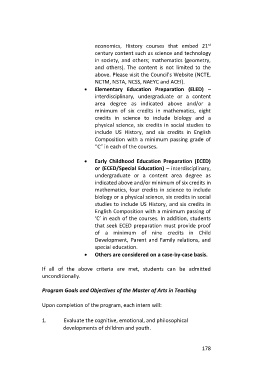
st
economics, History courses that embed 21
century content such as science and technology
in society, and others; mathematics (geometry,
and others). The content is not limited to the
above. Please visit the Council’s Website (NCTE,
NCTM, NSTA, NCSS, NAEYC and ACEI).
Elementary Education Preparation (ELED) –
interdisciplinary, undergraduate or a content
area degree as indicated above and/or a
minimum of six credits in mathematics, eight
credits in science to include biology and a
physical science, six credits in social studies to
include US History, and six credits in English
Composition with a minimum passing grade of
“C” in each of the courses.
Early Childhood Education Preparation (ECED)
or (ECED/Special Education) – interdisciplinary,
undergraduate or a content area degree as
indicated above and/or minimum of six credits in
mathematics, four credits in science to include
biology or a physical science, six credits in social
studies to include US History, and six credits in
English Composition with a minimum passing of
‘C’ in each of the courses. In addition, students
that seek ECED preparation must provide proof
of a minimum of nine credits in Child
Development, Parent and Family relations, and
special education.
Others are considered on a case-by-case basis.
If all of the above criteria are met, students can be admitted
unconditionally.
Program Goals and Objectives of the Master of Arts in Teaching
Upon completion of the program, each intern will:
1. Evaluate the cognitive, emotional, and philosophical
developments of children and youth.
178

