


Page 280 - 20818_park-c_efi
P. 280
9


                                                                                                  The Iggros Moshe also adds that if a healthy person is caring for a           #
                                                                                               patient whose illness is contagious and he needs a vaccination in order
                                                                                               to prevent contagion from the patient, he is allowed to be vaccinated
                                                                                               even if it involves desecration of Shabbos. It is known that the Gaon,
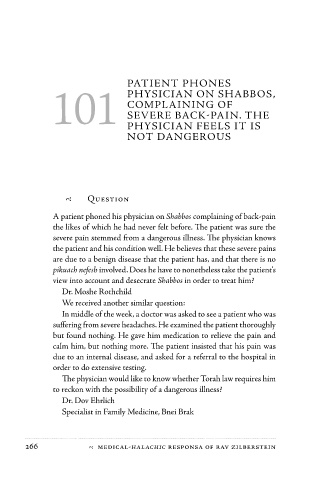
                                   PATIENT PHONES
                                                                                               Rav Yisrael of Salant zt”l, instructed people to eat on Yom Kippur at
               101                 PHYSICIAN ON SHABBOS,                                       a time when cholera was rampant, in order to avoid contracting the
                                   COMPLAINING OF
                                                                                               contagious disease.
                                   SEVERE BACK-PAIN. THE
                                                                                                  Although there is a slight possibility of rejecting the proof of
                                   PHYSICIAN FEELS IT IS                                       the Iggros Moshe, by claiming that tsafdina in the teeth and in the
                                   NOT DANGEROUS                                               intestines are one and the same disease, which begins in the mouth
                                                                                               and ends up in the intestines; it thus emerges that the disease in the
                                                                                               mouth is the beginning stage of the intestinal illness. We have not yet
                                                                                               seen that if mild disease is likely to lead to a dangerous disease, we can
                                                                                               already view the patient as being endangered? Nonetheless, it seems
                   1    Question Physician discounts possible dangeR of back-pain              that the words of the Iggros Moshe are clear.                                    20818_efi-ab - 20818_park-C_efi-ab | 9 - A | 18-08-20 | 13:46:24 | SR:-- | Magenta
                                                                                                  However, I found that another Gaon seems to say the opposite. The             #20818_efi-ab - 20818_park-C_efi-ab | 9 - A | 18-08-20 | 13:46:24 | SR:-- | Yellow  20818_efi-ab - 20818_park-C_efi-ab | 9 - A | 18-08-20 | 13:46:24 | SR:--
               A patient phoned his physician on Shabbos complaining of back-pain              Gilyon Mahara’i (of Rav Avraham Yonah Jewnin, z”l, from Horadna,
               the likes of which he had never felt before. The patient was sure the           printed at the end of the Mishnayos, Zera’im, Vilna edition) writes
               severe pain stemmed from a dangerous illness. The physician knows               that we learn in Tractate Berachos (Ch. 5:1): Even if a snake is wound
               the patient and his condition well. He believes that these severe pains         around his ankle, he should not interrupt his prayer, to which the
               are due to a benign disease that the patient has, and that there is no          Rambam explains (in his Mishnah Commentary, ibid) that in most
               pikuach nefesh involved. Does he have to nonetheless take the patient’s         cases the snake does not bite. The Acharonim wonder (see Rashash,
               view into account and desecrate Shabbos in order to treat him?                  ibid, and in his Chiddushim on Berachos 33a; Responsa Shoe’l Umeis-
                  Dr. Moshe Rothchild                                                          hiv, first edition, Vol. 1 #254): We do not follow the majority when it
                  We received another similar question:                                        comes to pikuach nefesh. Should we not, then, be concerned about the
                  In middle of the week, a doctor was asked to see a patient who was           minority of snakes who bite?
               suffering from severe headaches. He examined the patient thoroughly                The Gilyon Mahara’i answers (in the Gilyon of the Mishnah, there),
               but found nothing. He gave him medication to relieve the pain and               as follows:
               calm him, but nothing more. The patient insisted that his pain was                 In my humble opinion, regarding all these matters, one should
               due to an internal disease, and asked for a referral to the hospital in         not look at what has not yet occurred, but only at what there is at
               order to do extensive testing.                                                  that time. This is like a patient who is not in danger, where we have
                  The physician would like to know whether Torah law requires him              no right to desecrate Shabbos for him even though there is concern
               to reckon with the possibility of a dangerous illness?                          that his present disease will lead to another disease which will put
                  Dr. Dov Ehrlich                                                              him in danger. If we desecrate Shabbos for him now, we may prevent
                  Specialist in Family Medicine, Bnei Brak                                     him from contracting another disease. In my humble opinion, the


        266              1  Medical-HalacHic Responsa of Rav ZilbeRstein                       Non-Dangerous Disease  2                                        251

