


Page 20 - AHATA
P. 20
a7
                                                                                                           local Monday 27 october 2025


            Snakes of Aruba


            Arikok National Park is home to various unique plant and animal species
            such as Aruba’s rare endemic rattlesnake Crotalus unicolor). This rattle-
            snake is locally known as the ‘Cascabel’. But Aruba has two more snake
            species living on the island: the Santanero and the Boa.


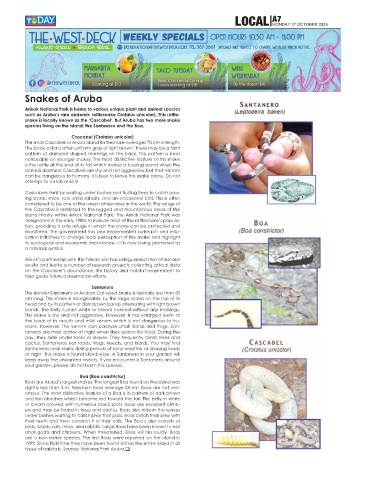
                                 Cascabel (Crotalus unicolor)
            The small Cascabel or Aruba Island Rattlesnake averages 70 cm in length.
            The body color is often uniform gray or light brown. There may be a faint
            pattern of diamond shaped markings on the back. This pattern is most
            noticeable on younger snakes. The most distinctive feature of this snake
            is the rattle at the end of its tail which makes a buzzing sound when the
            snake is alarmed. Cascabels are shy and not aggressive, but their venom
            can be dangerous to humans. It is best to leave this snake alone. Do not
            attempt to catch or kill it.

            Cascabels hunt by waiting under bushes and fruiting trees to catch pass-
            ing lizards, mice, rats, small rabbits, and an occasional bird. This is often
            considered to be one of the rarest rattlesnakes in the world. The range of
            the Cascabel is restricted to the rugged and mountainous areas of the
            island mostly within Arikok National Park. The Arikok National Park was
            designated in the early 1980s to include most of the rattlesnake’s popula-
            tion, providing a safe refuge in which the snake can be protected and
            monitored. The government has also implemented outreach and edu-
            cation initiatives to change local perception of the snake and highlight
            its ecological and economic importance – it is now being promoted as
            a national symbol.

            Arikok’s partnership with the Toledo zoo has safeguarded the rattlesnake
            ex-situ and led to a number of research projects collecting critical data
            on the Cascabel’s abundance, life history and habitat requirement to
            help guide future conservation efforts.

                                          Santanero
            The slender Santanero or Aruban Cat-eyed Snake is typically less than 50
            cm long. This snake is recognizable by the large scales on the top of its
            head and by its pattern of dark brown bands alternating with light brown
            bands. The belly is plain white or cream colored without any markings.
            This snake is shy and not aggressive. However, it has enlarged teeth at
            the back of its mouth and mild venom which is not dangerous to hu-
            mans. However, the venom can paralyze small lizards and frogs. San-
            taneros are most active at night when they search for food. During the
            day, they hide under rocks or leaves. They frequently climb trees and
            cactus. Santaneros eat toads, frogs, insects, and lizards. You may find
            Santaneros near dams during periods of rainy weather or crossing roads
            at night. This snake is found island wide. A Santanero in your garden will
            keep away the unwanted insects. If you encounter a Santanero around
            your garden, please do not harm this species.

                                     Boa (Boa constrictor)
            Boas are Aruba’s largest snakes. The longest Boa found on the island was
            slightly less than 3 m. Newborn Boas average 35 cm. Boas are not ven-
            omous. The most distinctive feature of a Boa is its pattern of dark brown
            and tan blotches which become red toward the tail. The belly in white
            or cream colored with numerous black spots. Boas are excellent climb-
            ers and may be found in trees and cactus. Boas also hide in the leaves
            under bushes waiting to catch prey that pass. Boas catch their prey with
            their teeth and then constrict it in their coils. The Boa’s diet consists of
            birds, lizards, rats, mice, and rabbits. Large Boas have been known to eat
            small goats and chickens. When threatened, Boas will hiss loudly. Boas
            are a non-native species. The first Boas were reported on the island in
            1999. Since that time they have been found across the entire island in all
            types of habitats. Source: National Park Aruba.q

