


Page 24 - AHATA
P. 24
a11
                                                                                                           local Monday 27 october 2025
            The district of Savaneta: A quick history guide to the island’s first capital


            (Oranjestad)—Before  Oranjestad
            became  the  island  nation’s  capi-
            tal,  Aruba’s  first  capital  was  the
            district of Savaneta. Here is where
            the  cultural  identity  of  Aruba  was
            born,  and  from  where  the  rest  of
            the island developed into what it is
            today.

            Savaneta is said to have been the
            first place where the Caquetio in-
            habitants first stepped foot on the
            island. Though there isn’t hard evi-
            dence to back this up, but consid-
            ering  the  legend  of  the  Cacique
            Arua, it is believed that there were
            already  movements  on  Aruba—
            and Savaneta—around 88 AD.

            The  Caquetios  probably  made
            their way to the island either from
            Venezuela, Colombia or other Ca-
            ribbean  islands  in  the  region,  but
            with good weather it was relatively
            easy for them to travel back and
            forth in their canoes. So, since the
            Caquetios  discovered  the  island,
            Aruba found her first form of civili-
            zation.                             dye or paint. But since these trees  neta. This way, Savaneta officially  Because of its land surface, Sava-
                                                could  not  be  found  in  Savaneta,  became the island’s first capital.  neta  was  a  great  place  to  con-
            It  wasn’t  until  1499  when  Aruba   he continued to search in the area                                   struct cattle farms. From here, the
            met another group of people who     of  what  is  now  known  as  Santa  However,  at  the  end  of  the  18th  farmer culture on Aruba was born.
            set  foot  on  the  island:  the  Span-  Cruz. The best way to transport the  century,  the  commander  at  the  Before the Aruban Gold Rush and
            ish  explorer  Alonso  de  Ojeda.  De   tree barks was via a route passing  time, J.R. Lauffer, moved his office  the construction of the Refinery in
            Ojeda first took notice of Aruba off   through Savaneta, and so the first  to what is now “Horse Bay” in Oran-  San  Nicolas,  most  residents  were
            the coast of Venezuela, during his   road between Savaneta and San-     jestad. Because the highest office  farmers, and Savaneta had many
            exploration  of  the  Latin  American   ta Cruz was made.               on  the  island  moved  away  from  inhabitants  that  farmed  fruits  and
            country.  This  was  on  August  9th,                                   Savaneta, the capital lost its title to  vegetables.  They  also  continued
            1499.  However,  de  Ojeda  didn’t   The Dutch colonial era (1636-1805)  what was called then Playa.        the  tradition  of  raising  cattle,  like
            actually sail to the island till 4 days   During  the  80-year  war  between                                goat,  sheep,  pigs  and  horses.  Sa-
            later, on August 23rd, 1499. This was   The Netherlands and Spain, Dutch                                    vaneta was one of the first places
            the  beginning  of  the  Spanish  era   explorers  and  merchants  began    How Savaneta got its name       on  the  island  to  have  a  general
            on Aruba (1499-1636).               to travel to the ABC islands. Once  The  name  Savaneta  probably  farming  culture.  From  this  culture,
                                                they landed in Aruba, they deport-  has  a  Spanish  origin.  It  was  said  many  other  traditions  were  born,
            Alonso usually didn’t stop at every   ed the small Arawakan and Span-   that  when  the  Spanish  climbed  a  like  the  Dera  Gay  Holiday  that
            island  or  land  he  saw,  especially   ish  community  that  was  living  on  hill called Yara, they saw that the  we celebrate every year on June
            not in the Caribbean. He would of-  the  island.  This  was  the  beginning  area was mostly open and had no  24th.q
            ten  take  notice  of  land  from  afar   of colonization of the ABC islands  big  trees.  In  Spanish,  such  a  land   Source: Historia di Savaneta (History of
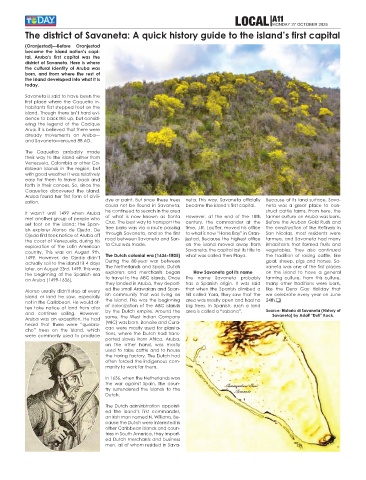
            and  continue  sailing.  However,   by  the  Dutch  empire.  Around  the  area is called a “sabana”.           Savaneta) by Adolf “Dufi” Kock.
            Aruba was an exception. He had      same,  the  West  Indian  Company
            heard  that  there  were  “quebra-  (WIC) was born. Bonaire and Cura-
            cho”  trees  on  the  island,  which   cao  were  mostly  used  for  planta-
            were commonly used to produce       tions, where the Dutch had trans-
                                                ported  slaves  from  Africa.  Aruba,
                                                on  the  other  hand,  was  mostly
                                                used to raise cattle and to house
                                                the haring factory. The Dutch had
                                                often forced the indigenous com-
                                                munity to work for them.

                                                In 1636, when the Netherlands won
                                                the  war  against  Spain,  the  coun-
                                                try  surrendered  the  islands  to  the
                                                Dutch.

                                                The Dutch administration appoint-
                                                ed  the  island’s  first  commander,
                                                an Irish man named N. Williams. Be-
                                                cause the Dutch were interested in
                                                other Caribbean islands and coun-
                                                tries in South America, they import-
                                                ed Dutch merchants and business
                                                men, all of whom resided in Sava-

