


Page 9 - AHATA
P. 9
a7
                                                                                                           local Friday 14 November 2025
            Visit the natural bridges of Aruba!


                                                            frequently visited beach, as the bridge had a  coastline and the Caribbean Sea. Visitors can
                                                            small opening through which the water would  also still visit the souvenir shop on the left of the
                                                            flow into the tiny beach.                       bridge entrance.
                                                            Unfortunately  in  2005,  the  bridge  collapsed,
                                                            and the little beach dried up. Despite this, this  While the natural bridge no longer is functional,
                                                            site remained a tourist attraction, with many vis-  there is now a smaller natural bridge very close.
                                                            itors walking along the coral cliffs of the bridge  This bridge is often called the “Baby Bridge” or
                                                            to  see  the  spectacular  view  of  the  northern  “Daughter Bridge”.q


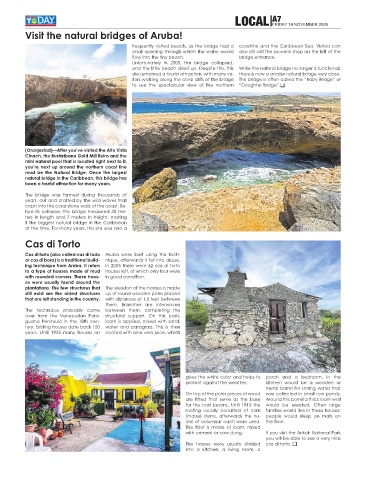
            (Oranjestad)—After you’ve visited the Alto Vista
            Church, the Bushiribana Gold Mill Ruins and the
            mini natural pool that is located right next to it,
            you’re next up around the northern coast line
            must  be  the  Natural  Bridge.  Once  the  largest
            natural bridge in the Caribbean, this bridge has
            been a tourist attraction for many years.


            The  bridge  was  formed  during  thousands  of
            years, cut and crafted by the wild waves that
            crash into the coral stone walls of the coast. Be-
            fore its collapse, this bridge measured 30 me-
            ters  in  length  and  7  meters  in  height,  making
            it the biggest natural bridge in the Caribbean
            at the time. For many years, this site was also a

            Cas di Torto


            Cas di torto (also called cas di lodo  Aruba  were  built  using  this  tech-
            or cas di bara) is a traditional build-  nique, afterwards it fell into disuse.
            ing technique from Aruba. It refers  In 2005 there were 62 cas di torto
            to a type of houses made of mud  houses left, of which only four were
            with rounded corners. These hous-   in good condition.
            es  were  usually  found  around  the
            plantations. The few structures that  The skeleton of the houses is made
            still  exist  are  the  oldest  structures  up of round wooden poles placed
            that are left standing in the country.  with distances of 1.5 feet between
                                                them.  Branches  are  interwoven
            The  technique  probably  came  between  them,  completing  the
            over  from  the  Venezuelan  Para-  structural  support.  On  this  basis,
            guaná  Peninsula  in  the  18th  cen-  loam is applied, mixed with sand,
            tury. Existing houses date back 150  water  and  paragrass.  This  is  then
            years.  Until  1925  many  houses  on  coated with aloe vera juice, which


                                                                                    gives the white color and helps to  porch  and  a  bedroom.  In  the
                                                                                    protect against the weather.        kitchen  would  be  a  wooden  or
                                                                                                                        metal barrel for storing water that
                                                                                    On top of the poles pieces of wood  was collected in small rain ponds.
                                                                                    are  fitted  that  serve  as  the  base  Around this barrel a thick loam wall
                                                                                    for  the  roof  beams.  Until  1815  the  would  be  erected.  Often  large
                                                                                    roofing  usually  consisted  of  corn  families would live in these houses;
                                                                                    (maize)  stems,  afterwards  the  nu-  people  would  sleep  on  mats  on
                                                                                    clei of columnar cacti were used.  the floor.
                                                                                    The  floor  is  made  of  loam,  mixed
                                                                                    with cement or cow dung.            If you visit the Arikok National Park
                                                                                                                        you will be able to see a very nice
                                                                                    The  houses  were  usually  divided  cas di torto. q
                                                                                    into  a  kitchen,  a  living  room,  a

