


Page 10 - AB
P. 10
a7
                                                                                                           local Saturday 22 November 2025
            Aruba’s kite flying tradition


                                                                                                   lines or thin rope to tie three  soccer  and  baseball  fields
                                                                                                   corners of the kite together.  found all around the island
                                                                                                   Another long string of rope  around noon, when the sun
            (Oranjestad)—Every year for  starts at home in the weeks  cornstarch  slurry  as  glue),  is tied in the knotted center  is at its brightest. In the past
            King’s Day, Arubans gather  leading  up  to  King’s  Day.  kids usually make their own  and  bundled  up,  used  to  few  years,  kite  flying  has
            with friends and family to fly  These  kites  were  tradition-  kites with their friends, par-  steer the kite as it flies in the  become  a  sport  in  which
            kites. Big or small, paper or  ally made with things found  ents  or  other  close  family  air. Decorating the kite was  groups of people would bat-
            plastic, blue skies fill up with  in  the  nearby  mondi*  and  members.  Tails  are  made  especially  important,  and  tle against each other to see
            these colorful flying contrap-  in the kitchen at home. Us-  from old bed sheets, ripped  children would use paint to  whose kite is the biggest, the
            tions, brightening our yearly  ing dried up cactus sticks for  and tied together to create  create their own designs—  prettiest, and whose could
            celebration  of  the  Dutch  the frame, old news papers,  a long string of fabric trail-  the more colorful, the better!  fly  flawlessly  and  longer  in
            Monarch.                     and glue made from flour,  ing  behind  the  back  end                                 the air.
                                         water and salt to dry faster  of the kite. To finish off the  People usually fly their kites
            The  tradition  of  flying  kites  (some  people  even  use  process,  people  used  fish  in big open fields, like empty  *Mondi: Aruban woods.q


             The Aruban way of life: Creating community with Cas di Torto


            (Oranjestad)—The  Aruban  people  tury in the Paraguana Peninsula in  to  flow  freely  through  the  house.
            understand  that  a  happy  life  is  Venezuela.  Refugees  who  sought  This method of roofing was known
            spent in great ambience with your  sanctuary  on  Aruba  introduced  throughout  the  ABC  islands  (Aru-
            loved ones. Passed down from one  this building method to the island.    ba,  Curacao,  Bonaire),  but  the
            generation  to  the  other,  building                                    use of cornstalks in Aruba eventu-
            community has been a key aspect  The uprights of the walls were made  ally got replaced with use of mud
            in  forging  our  traditions  and  cus-  with  sturdy  and  straight  wayaca  and white plaster for the roofs. The
            toms. The Cas di Torto (mud house)  or  kwihi  wood,  or  from  thin  man-  white plaster all around made the
            played  a  big  role  in  cultivating  grove struts. Then, the wattle walls  houses looks like cake, hence the
            community,  bridging  families  to-  were  weaved  in  using  branches  name “Torto” (Spanish for “cake”).
            gether  and  forming  close  bonds  and twigs from the warero and si-
            with  your  neighbors—something  sal  plant,  daubed  with  a  mixture  Building community
            we highly value today.               of grass and mud. Finally, the walls  Building  Torto  houses  was  often  a
                                                 got a coat of white plaster to seal  community  effort.  Young  couples
            Cas di Torto: History and construc-  everything in.                      who  were  about  to  get  married
            tion                                                                     had  to  have  their  house  built  be-
            The origin of the Cas di Torto is said  For roofing, corn stalks, palm fonds  fore  they  could  tie  the  knot  and
            to date back to the early 19th cen-  and straws were used, allowing air  start their own family. This is where
                                                                                     the help of the community comes
                                                                                     into play.                          and mixing the mud.

                                                                                     Neighbors,  extended  family  and   The average duration of construct-
                                                                                     friends  would  all  help  in  the  con-  ing a Cas di Torto was 4 months.
                                                                                     struction of a Torto House. And ev-
                                                                                     eryone had a role: The men over-    At the end of a long day of work,
                                                                                     saw the building of the house, and   everyone  would  gather  around
                                                                                     the women were tasked with col-     and enjoy a feast of hearty food.
                                                                                     lecting wood and straws, cooking    This type of help from friends and
                                                                                     and taking care of the little ones.  family became a tradition and was
                                                                                                                         called  “paga  lomba”:  You  help
                                                                                     The couple’s family were primarily   me today; I’ll help you tomorrow.
                                                                                     responsible  for  feeding  everyone
                                                                                     who  helped  build  the  house.  Be-  Nowadays, traditional Cas di Torto
                                                                                     fore construction, someone usually   are rare, especially those that are
                                                                                     had the task to prepare the meal;   still inhabited. Houses that do exist
                                                                                     going fishing or slaughter farm ani-  probably date back more than a
                                                                                     mals like goats, chicken or sheep.   century.q
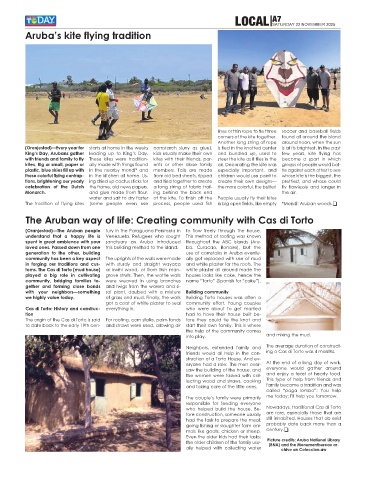
                                                                                     Even the older kids had their tasks;   Picture credits: Aruba National Library
                                                                                     the older children of the family usu-  (BNA) and the Monumentbureau ar-
                                                                                     ally  helped  with  collecting  water     chive on Coleccion.aw

