


Page 13 - AT
P. 13
A13
                                                                                                                           Friday 8 November 2019


             Fundacion Parke Nacional Aruba:
             Parke Marino Aruba enters transition phase


                                                                      For the community in gener-
                                                                      al, as well as for the specific
                                                                      stakeholders, it is important
                                                                      to know that no change in
                                                                      usage  of  the  marine  pro-
                                                                      tected areas has yet been
                                                                      imposed. However, nation-
                                                                      al  laws  remain  enforced
                                                                      throughout    the   marine
                                                                      environment,  i.e.  concern-
                                                                      ing protected species and
                                                                      specific fishing methods. A
                                                                      change that will be visible
                                                                      from  the  onset  is  the  in-
                                                                      creased presence of FPNA
                                                                      marine park rangers in   the
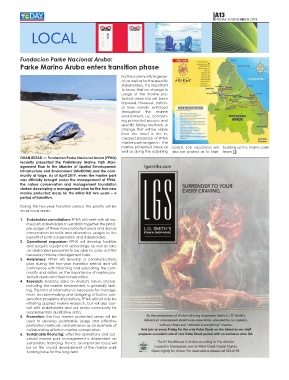
                                                                      marine protected areas as  coasts.  Job  vacancies  will  building up the marine park
                                                                      well as along the adjoining  also  be  posted  as  to  start  team.q
             ORANJESTAD — Fundacion Parke Nacional Aruba (FPNA)
             recently  presented  the  Preliminary  Marine  Park  Man-
             agement  Plan  to  the  Minister  of  Spatial  Development,
             Infrastructure and Environment (MinROIM) and the com-
             munity at large. As of April 2019, when the marine park
             was officially brought under the management of FPNA,
             the  nature  conservation  and  management  foundation
             started developing a management plan for the four new
             marine protected areas for the initial first two years – a
             period of transition.

             During this two-year transition period, the priority will be
             on six focal areas:

             1.  Stakeholder consultations: FPNA will meet with all ma-
                rine park stakeholders to establish together the princi-
                ple usages of these now protected areas and discuss
                conservation benefits and alternative usages to the
                benefit of both conservation and stakeholders.
             2.  Operational  expansion:  FPNA  will  develop  facilities
                and acquire equipment accordingly as well as take
                on dedicated personnel to be able to carry out the
                necessary marine management tasks.
             3.  Awareness:  FPNA  will  develop  a  communications
                plan  during  the  two-year  transition  period  and  will
                commence with informing and educating the com-
                munity and visitors on the importance of marine pro-
                tected areas and their conservation.
             4.  Research: baseline data on Aruba’s nature (status),
                including the marine environment, is generally lack-
                ing. This kind of information is necessary for manage-
                ment decision-making and designing effective con-
                servation programs and actions. FPNA will not only be
                initiating applied marine research, but will also con-
                sult with stakeholders and our senior community for
                supplementary qualitative data.
             5.  Promotion:  the  four  marine  protected  areas  will  be
                used  to  develop  sustainable  usage  and  effective
                protection methods, and will serve as an example of
                collaborative efforts in marine conservation.
             6.  Sustainable financing: effective operations and suc-
                cessful  marine  park  management  is  dependent  on
                sustainable financing. Hence, an important focus will
                be on the crucial development of the marine park
                funding base for the long term.

