


Page 5 - AHATA
P. 5
a7
                                                                                                           local Tuesday 28 OcTOber 2025
            Visit the island’s popular cave sites!


            (Oranjestad)—Among the endless sea of dark brown sand and
            cacti, there are two caves hidden in the outskirts of San Nico-
            las, in the north-eastern area of the island. These caves, The
            Quadiriki  cave  and  The  Fontein  Cave  are  open  to  visitors  of
            the Arikok National Park, so if you ever decide to take an “off-
            road” tour in the park, be sure to visit these prehistoric caves…
            and be sure to bring a flashlight!

                                   Quadirikiri Cave
            Known for its two chambers accompanied by a skylight, the
            Quadikiri  Cave  is  the  most  popular  cave  among  locals  and
            tourists, as it is easy to walk through and provides great lighting
            for pictures.

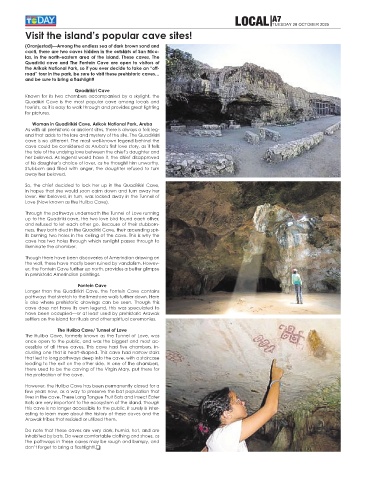
                Woman in Quadirikiri Cave, Arikok National Park, Aruba
            As with all prehistoric or ancient sites, there is always a folk leg-
            end that adds to the lore and mystery of the site. The Quadirikiri
            cave is no different. The most well-known legend behind the
            cave could be considered as Aruba’s first love story, as it tells
            the tale of the undying love between the chief’s daughter and
            her beloved. As legend would have it, the chief disapproved
            of his daughter’s choice of lover, as he thought him unworthy.
            Stubborn and filled with anger, the daughter refused to turn
            away her beloved.

            So, the chief decided to lock her up in the Quadirikiri Cave,
            in hopes that she would soon calm down and turn away her
            lover. Her beloved, in turn, was locked away in the Tunnel of
            Love (Now known as the Huliba Cave).

            Through the pathways underneath the Tunnel of Love running
            up to the Quadiriki cave, the two love bird found each other,
            and refused to let each other go. Because of their stubborn-
            ness, they both died in the Quadiriki Cave, their ascending spir-
            its burning two holes in the ceiling of the cave. This is why the
            cave has two holes through which sunlight passes through to
            illuminate the chamber.

            Though there have been discoveries of Amerindian drawing on
            the wall, these have mostly been ruined by vandalism. Howev-
            er, the Fontein Cave further up north, provides a better glimpse
            in prehistoric Amerindian paintings.

                                    Fontein Cave
            Longer than the Quadirikiri Cave, the Fontein Cave contains
            pathways that stretch to the limestone walls further down. Here
            is  also  where  prehistoric  drawings  can  be  seen.  Though  this
            cave  does  not  have  its  own  legend,  this  was  speculated  to
            have been occupied—or at least used by prehistoric Arawak
            settlers on the island for rituals and other spiritual ceremonies.

                           The Huliba Cave/ Tunnel of Love
            The Huliba Cave, formerly known as the Tunnel of Love, was
            once open to the public, and was the biggest and most ac-
            cessible  of  all  three  caves.  This  cave  had  five  chambers,  in-
            cluding one that is heart-shaped. This cave had narrow stairs
            that led to long pathways deep into the cave, with a staircase
            leading to the exit on the other side. In one of the chambers,
            there used to be the carving of the Virgin Mary, put there for
            the protection of the cave.

            However, the Huliba Cave has been permanently closed for a
            few years now, as a way to preserve the bat population that
            lives in the cave. These Long Tongue Fruit Bats and Insect Eater
            Bats are very important to the ecosystem of the island. Though
            this cave is no longer accessible to the public, it surely is inter-
            esting to learn more about the history of these caves and the
            Arawak tribes that resided or utilized them.

            Do note that these caves are very dark, humid, hot, and are
            inhabited by bats. Do wear comfortable clothing and shoes, as
            the pathways in these caves may be rough and bumpy, and
            don’t forget to bring a flashlight!.q

