


Page 28 - aruba-today-20170408
P. 28
A28
SCIENCESaturday 8 April 2017
‘BioBlitz’ scientists to survey California desert valley
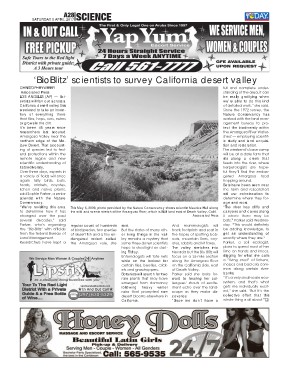
CHRISTOPHER WEBER This May 6, 2009, photo provided by the Nature Conservancy shows scientist Maurice Hall along full and complete under-
Associated Press the wild and scenic stretch of the Amargosa River, which is BLM land east of Death Valley, Calif. standing of the area, it can
LOS ANGELES (AP) — Sci- be really gratifying when
entists will fan out across a Associated Press we’re able to do this kind
California desert valley this of detailed work,” she said.
weekend to take an inven- regular count of hundreds said. And mammologists will Since the 1972 survey, the
tory of everything there of bird species, two species But the status of many oth- track footprints and scat in Nature Conservancy has
that flies, hops, runs, swims of desert fish and a tiny en- er living things in the val- the hopes of spotting bob- worked with the land man-
or grows in the dirt. dangered rodent called ley remains a mystery that cats, mountain lions, coy- agement bureau to pro-
It’s been 45 years since the Amargosa vole, she some three dozen scientists otes, rabbits and kit foxes. tect the biodiversity within
researchers last scoured hope to shed light on start- The valley stretches into the Amargosa River Water-
Amargosa Valley near the ing Friday. Nevada but the Bio-Blitz will shed — employing scientif-
northern edge of the Mo- Entomologists will tote nets focus on a 26-mile section ic study and land acquisi-
jave Desert. That account- while on the lookout for along the Amargosa River tion and restoration.
ing of species led to fed- certain flies, beetles, crick- on the California side, east The weekend’s base camp
eral protections within the ets and grasshoppers. of Death Valley. will be at a date farm that
remote region and new Botanists will search for two Parker said she looks for- sits along a creek that
scientific understanding of rare plants that may have ward to hearing her col- feeds into the river, where
its biodiversity. emerged from dormancy leagues’ shouts of excite- herpetologists are hope-
Over three days, experts in following heavy winter ment echo over the land- ful they’ll find the endan-
a variety of fields will once rains that prompted rare scape as they make dis- gered Amargosa toad
again tally birds, bats, desert blooms elsewhere in coveries. hopping around.
toads, crickets, coyotes, California. “Since we don’t have a Bats have been seen near
lichen and native plants, the farm and researchers
said Sophie Parker, a senior will use echolocation to
scientist with the Nature determine where they for-
Conservancy. age and roost.
“We’re revisiting this area “The river has cliffs and
to determine how it has canyons and caves along
changed over the past it where there may be
several decades,” said bats,” Parker said Wednes-
Parker, who’s organizing day. “This would definitely
the “Bio-Blitz” with officials be adding knowledge, to
from the federal Bureau of get an understanding of
Land Management. exactly where they are.”
Researchers have kept a Parker, a soil ecologist,
plans to spend most of her
time on hands and knees,
digging for what she calls
a “living crust” of lichens,
mosses and bacteria com-
mon along certain river-
banks.
“It’s a very small-scale eco-
system, and that’s what
gets me individually excit-
ed,” she said. “But it’s the
collective effort that this
whole thing is all about.”q

