


Page 135 - maintg
P. 135
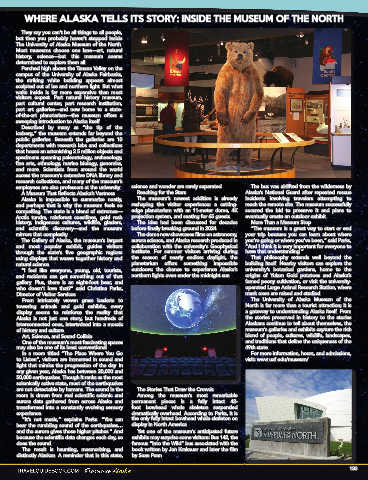
WHERE ALASKA TELLS ITS STORY: INSIDE THE MUSEUM OF THE NORTH

        They say you can’t be all things to all people,
      but then you probably haven’t stepped inside
      The University of Alaska Museum of the North.
      Most museums choose one lane—art, natural
      history, science—but this museum seems
      determined to explore them all.
        Perched high above the Tanana Valley on the
      campus of the University of Alaska Fairbanks,
      the  striking  white  building  appears  almost
      sculpted out of ice and northern light. But what
      waits  inside  is  far  more  expansive  than  most
      visitors expect. Part natural history museum,
      part cultural center, part research institution,
      part art galleries—and now home to a state-
      of-the-art planetarium—the museum offers a
      sweeping introduction to Alaska itself.
        Described by many as  “the tip  of the
      iceberg,” the museum extends far beyond the
      public galleries. Beneath  the galleries are  10
      departments with research labs and collections
      that house an astonishing 2.5 million objects and
      specimens spanning paleontology, archaeology,
      fine arts, ethnology, marine biology, genomics,
      and more. Scientists from around the world
      access the museum’s extensive DNA library and
      research collections, and many of the museum’s
      employees are also professors at the university.  science and wonder are rarely separated.  The bus was airlifted from the wilderness by
        A Museum That Reflects Alaska’s Vastness  Reaching for the Stars        Alaska’s National Guard after repeated rescue
        Alaska is impossible to summarize neatly,   The  museum’s newest  addition  is  already   incidents involving travelers attempting to
      and perhaps that is why the museum feels so   reshaping the visitor experience: a cutting-  reach the remote site. The museum successfully
      compelling. The state is a blend of extremes—  edge  planetarium  with  an  11-meter  dome,  4K   secured the bid to preserve it and plans to
      Arctic tundra, rainforest coastlines, gold rush   projection system, and seating for 65 guests.   eventually create an outdoor exhibit.
      history, Indigenous cultures, wildlife, glaciers,   The idea had been discussed for decades   More Than a Museum Stop
      and  scientific  discovery—and  the  museum   before finally breaking ground in 2024.  “The museum is a great way to start or end
      mirrors that complexity.               The dome now showcases films on astronomy,   your trip because you can learn about where
        The Gallery of Alaska, the museum’s largest   aurora science, and Alaska research produced in   you’re going or where you’ve been,” said Parks,
      and  most  popular  exhibit,  guides  visitors   collaboration with the university’s Geophysical   “And I think it is very important for everyone to
      through  the  state’s  five  geographic  regions   Institute. For summer visitors arriving during   have that understanding.”
      using displays that weave together history and   the season of nearly endless daylight, the   That philosophy extends well beyond the
      natural science.                     planetarium  offers  something  impossible  building itself. Nearby visitors can explore the
        “I feel like everyone, young, old, tourists,   outdoors: the chance to experience Alaska’s   university’s botanical gardens, home to the
      and residents can get something out of that   northern lights even under the midnight sun.   origins of Yukon Gold potatoes and Alaska’s
      gallery. Plus, there is an eight-foot bear, and                           famed peony cultivation, or visit the university-
      who doesn’t love that?” said Christina Parks,                             operated Large Animal Research Station, where
      Director of Visitor Services.                                             musk oxen are raised and studied.
        From intricately woven grass baskets to                                   The University of Alaska Museum of the
      towering animals and gold exhibits, every                                 North is far more than a tourist attraction; it is
      display seems to reinforce the reality that                               a gateway to understanding Alaska itself. From
      Alaska is not just one story, but hundreds of                             the stories preserved in history to the stories
      interconnected ones, intertwined into a mosaic                            Alaskans continue to tell about themselves, the
      of history and culture.                                                   museum’s galleries and exhibits capture the rich
        Art, Science, and Sound Collide                                         blend of people, cultures, wildlife, landscapes,
        One of the museum’s most fascinating spaces                             and traditions that define the uniqueness of the
      may also be one of its least conventional.                                49th state.
        In a room titled “The Place Where You Go                                  For more information, hours, and admissions,
      to Listen”, visitors are immersed in sound and                            visit: www.uaf.edu/museum/
      light that mimics the progression of the day. In
      any given year, Alaska has between 20,000 and
      50,000 earthquakes. Though it ranks as the most
      seismically active state, most of the earthquakes
      are not detectable by humans. The sound in the   The Stories That Draw the Crowds
      room  is  drawn  from  real  scientific  seismic  and   Among the museum’s most remarkable
      aurora data gathered from across Alaska and   permanent pieces is a fully intact 42-
      transformed into a constantly evolving sensory   foot bowhead whale skeleton suspended
      experience.                          dramatically overhead. According to Parks, it is
        “It’s not music,” explains Parks. “You can   the only fully intact bowhead whale skeleton on
      hear the rumbling sound of the earthquakes…   display in North America.
      and the aurora gives those higher pitches.” And   Yet one of the museum’s anticipated future
      because the scientific data changes each day, so   exhibits may surprise some visitors: Bus 142, the
      does the sound.                      famous “Into the Wild” bus associated with the
        The result is haunting, mesmerizing, and   book written by Jon Krakauer and later the film
      distinctly Alaskan. A reminder that in this state,   by Sean Penn

                                                                                                                  133

