


Page 30 - Data Structures Interactive Book
P. 30
Chapter 3


              3.1   Introduction to Arrays

                       Arrays are one of the most fundamental data structures in C++. They provide a way to

               store multiple elements of the same type in a contiguous block of memory. Each element in

               an array is identified by an index, which allows constant-time access. Arrays are widely used
               because they are simple, efficient, and form the basis for more advanced structures such as

               matrices, strings, and hash tables.


                       3.1.1  Definition and Characteristics

                       An array is a collection of elements arranged sequentially in memory. All elements
               must be of the same data type, and the size of the array must be specified at the time of

               declaration. Arrays allow random access, meaning any element can be accessed directly using

               its index. However, the size of an array is fixed, which can be a limitation when dealing with

               dynamic data.


                       3.1.2  Declaration and Initialization


                       Arrays in C++ can be declared by specifying the data type, name, and size. Initialization

               can be done at the time of declaration or later in the program.

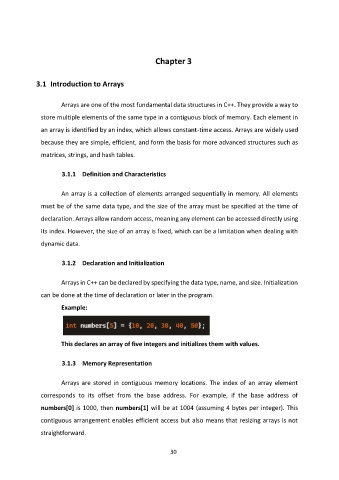
                       Example:


                       This declares an array of five integers and initializes them with values.


                       3.1.3  Memory Representation

                       Arrays  are  stored  in  contiguous  memory  locations.  The  index  of  an  array  element

               corresponds  to  its  offset  from  the  base  address.  For  example,  if  the  base  address  of

               numbers[0] is 1000, then numbers[1] will be at 1004 (assuming 4 bytes per integer). This

               contiguous arrangement enables efficient access but also means that resizing arrays is not
               straightforward.


                                                             30

