


Page 872 - The Toxicology of Fishes
P. 872
852                                                        The Toxicology of Fishes


                       The C  values were measured from 1-cm section samples of two radionuclide-dated sediment cores.
                           soc
                                       210
                       Two radionuclides ( Pb and   137 Cs) were used to estimate the chronologies of the sediment cores
                       (Goldberg, 1963; Krishnaswami et al., 1971; Robbins and Edgington, 1972), along with two dating
                       methods, to verify the accuracy of the aging (Appleby and Oldfield, 1978; Robbins, 1978; Robbins and
                       Herchle, 1993). The aging estimates derived from the two methods were nearly identical, as were the
                       resolutions provided by each estimation technique (Cook et al., 2003). BSAF  values were measured
                                                                                   egg
                       from samples collected from 1978 to 1988. These empirical values for BSAF  intrinsically account for
                                                                                 egg
                       differences in bioaccumulation for each of the congeners, as these factors are specific to species, life
                       stage, tissues, and locations. For periods prior to 1972 the BSAF  values required adjustment due to
                                                                         egg
                       the fact that larger concentrations of the chemicals existed in the water relative to concentrations in the
                       surface sediments. Because BSAFs are by definition normalized to C , increased uptake of the chemicals
                                                                          soc
                       via water (pelagic food chain) with respect to uptake via sediment (benthic food chain) will increase
                       the BSAF  values in proportion to the amount of increased bioaccumulation by lake trout (Burkhard
                              egg
                       et al., 2003).
                        The expected pre-1970s greater BSAF   values were modeled based on predicted decreases in the
                                                      egg
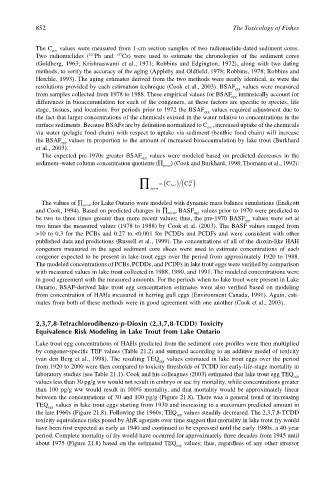
                       sediment–water column concentration quotients (∏ socw ) (Cook and Burkhard, 1998; Thomann et al., 1992):
                                                      ∏     = C (  soc) ( )
                                                                     fd
                                                                   C
                                                                     w
                                                         socw
                        The values of ∏ socw  for Lake Ontario were modeled with dynamic mass balance simulations (Endicott
                       and Cook, 1994). Based on predicted changes in ∏ socw , BASF  values prior to 1970 were predicted to
                                                                      egg
                       be two to three times greater than more recent values; thus, the pre-1970 BASF  values were set at
                                                                                     egg
                       two times the measured values (1978 to 1988) by Cook et al. (2003). The BASF values ranged from
                       >10 to 0.3 for the PCBs and 0.27 to <0.001 for PCDDs and PCDFs and were consistent with other
                       published data and predictions (Russell et al., 1999). The concentrations of all of the dioxin-like HAH
                       congeners measured in the aged sediment core slices were used to estimate concentrations of each
                       congener expected to be present in lake trout eggs over the period from approximately 1920 to 1988.
                       The modeled concentrations of PCBs, PCDDs, and PCDFs in lake trout eggs were verified by comparison
                       with measured values in lake trout collected in 1988, 1990, and 1991. The modeled concentrations were
                       in good agreement with the measured amounts. For the periods when no lake trout were present in Lake
                       Ontario, BSAF-derived lake trout egg concentration estimates were also verified based on modeling
                       from concentration of HAHs measured in herring gull eggs (Environment Canada, 1991). Again, esti-
                       mates from both of these methods were in good agreement with one another (Cook et al., 2003).


                       2,3,7,8-Tetrachlorodibenzo-p-Dioxin (2,3,7,8-TCDD) Toxicity
                       Equivalence Risk Modeling in Lake Trout from Lake Ontario
                       Lake trout egg concentrations of HAHs predicted from the sediment core profiles were then multiplied
                       by congener-specific TEF values (Table 21.2) and summed according to an additive model of toxicity
                       (van den Berg et al., 1998). The resulting TEQ  values estimated in lake trout eggs over the period
                                                            egg
                       from 1920 to 2000 were then compared to toxicity thresholds of TCDD for early-life-stage mortality in
                       laboratory studies (see Table 21.1). Cook and his colleagues (2003) estimated that lake trout egg TEQ egg
                       values less than 30 pg/g ww would not result in embryo or sac fry mortality, while concentrations greater
                       than 100 pg/g ww would result in 100% mortality, and that mortality would be approximately linear
                       between the concentrations of 30 and 100 pg/g (Figure 21.8). There was a general trend of increasing
                       TEQ  values in lake trout eggs starting from 1930 and increasing to a maximum predicted amount in
                          egg
                       the late 1960s (Figure 21.8). Following the 1960s, TEQ  values steadily decreased. The 2,3,7,8-TCDD
                                                                 egg
                       toxicity equivalence risks posed by AhR agonists over time suggest that mortality in lake trout fry would
                       have been first expected as early as 1940 and continued to be expressed until the early 1980s, a 40-year
                       period. Complete mortality of fry would have occurred for approximately three decades from 1945 until
                       about 1975 (Figure 21.8) based on the estimated TEQ  values; thus, regardless of any other stressor
                                                                 egg

