


Page 150 - MAT KS3 Y8 Cambridge CheckPoint
P. 150
15 Probability


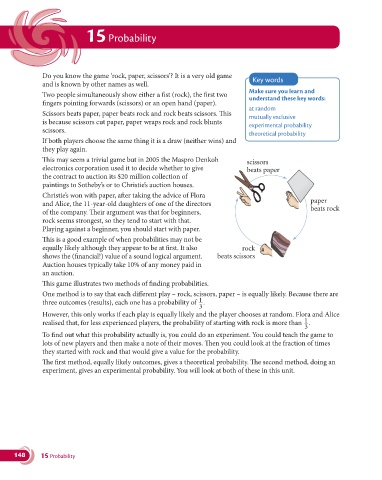
               Do you know the game ‘rock, paper, scissors’? It is a very old game   Key words
               and is known by other names as well.
                                                                                    Make sure you learn and
               Two people simultaneously show either a fist (rock), the first two
                                                                                    understand these key words:
               fingers pointing forwards (scissors) or an open hand (paper).
                                                                                    at random
               Scissors beats paper, paper beats rock and rock beats scissors. This   mutually exclusive
               is because scissors cut paper, paper wraps rock and rock blunts      experimental probability
               scissors.
                                                                                    theoretical probability
               If both players choose the same thing it is a draw (neither wins) and
               they play again.

               This may seem a trivial game but in 2005 the Maspro Denkoh          scissors
               electronics corporation used it to decide whether to give           beats paper
               the contract to auction its $20 million collection of
               paintings to Sotheby’s or to Christie’s auction houses.
               Christie’s won with paper, after taking the advice of Flora
               and Alice, the 11-year-old daughters of one of the directors                              paper
               of the company. Their argument was that for beginners,                                    beats rock
               rock seems strongest, so they tend to start with that.
               Playing against a beginner, you should start with paper.
               This is a good example of when probabilities may not be
               equally likely although they appear to be at first. It also        rock
               shows the (financial!) value of a sound logical argument.   beats scissors
               Auction houses typically take 10% of any money paid in
               an auction.
               This game illustrates two methods of finding probabilities.

               One method is to say that each different play – rock, scissors, paper – is equally likely. Because there are
                                                                   1
               three outcomes (results), each one has a probability of  .
                                                                   3
               However, this only works if each play is equally likely and the player chooses at random. Flora and Alice
                                                                                                       1
               realised that, for less experienced players, the probability of starting with rock is more than  .
                                                                                                       3
               To find out what this probability actually is, you could do an experiment. You could teach the game to
               lots of new players and then make a note of their moves. Then you could look at the fraction of times
               they started with rock and that would give a value for the probability.
               The first method, equally likely outcomes, gives a theoretical probability. The second method, doing an
               experiment, gives an experimental probability. You will look at both of these in this unit.


      148      15 Probability

