


Page 154 - MAT KS3 Y8 Cambridge CheckPoint
P. 154
15.3 Listing all possible outcomes


               15.3 Listing all possible outcomes

                                                                                              blue dice
               If you throw two dice together, what is the
               probability of getting a double six?                                 1     2    3    4     5    6
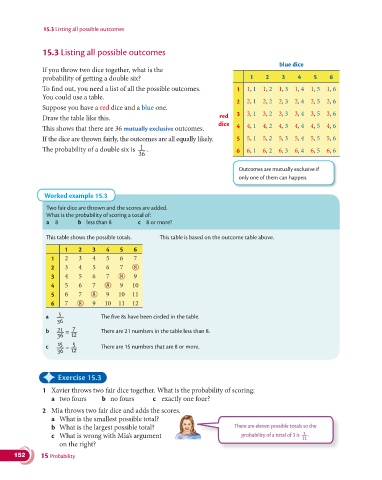
               To find out, you need a list of all the possible outcomes.       1  1, 1  1, 2  1, 3  1, 4  1, 5  1, 6
               You could use a table.
                                                                                2  2, 1  2, 2  2, 3  2, 4  2, 5  2, 6
               Suppose you have a red dice and a blue one.
               Draw the table like this.                                  red   3  3, 1  3, 2  3, 3  3, 4  3, 5  3, 6
                                                                          dice     4, 1  4, 2  4, 3  4, 4  4, 5  4, 6
               This shows that there are 36 mutually exclusive outcomes.        4
               If the dice are thrown fairly, the outcomes are all equally likely.  5  5, 1  5, 2  5, 3  5, 4  5, 5  5, 6
               The probability of a double six is   1  .                        6  6, 1  6, 2  6, 3  6, 4  6, 5  6, 6
                                               36


                                                                                 Outcomes are mutually exclusive if
                                                                                 only one of them can happen.


                Worked example 15.3

                Two fair dice are thrown and the scores are added.
                What is the probability of scoring a total of:
                a 8        b  less than 8      c  8 or more?

                This table shows the possible totals.   This table is based on the outcome table above.
                       1   2    3   4    5    6
                  1    2   3    4   5    6    7
                  2    3   4    5   6    7    8
                  3    4   5    6   7    8    9
                  4    5   6    7   8    9   10
                  5    6   7    8   9    10  11
                  6    7   8    9   10   11  12
                     5
                a                  The five 8s have been circled in the table.
                    36
                b   21  =  7       There are 21 numbers in the table less than 8.
                    36   12
                    15   5
                c      =           There are 15 numbers that are 8 or more.
                    36   12


               ✦     Exercise 15.3


               1  Xavier throws two fair dice together. What is the probability of scoring:
                  a  two fours     b no fours       c exactly one four?

               2  Mia throws two fair dice and adds the scores.
                  a  What is the smallest possible total?
                  b  What is the largest possible total?                       There are eleven possible totals so the
                                                                                                      1
                  c   What is wrong with Mia’s argument                           probability of a total of 3 is   11  .
                     on the right?
      152      15 Probability

