


Page 158 - MAT KS3 Y8 Cambridge CheckPoint
P. 158
15.4 Experimental and theoretical probabilities


                  Anders made a dice and threw it 300 times.
                                                                              Score      1    2   3    4   5    6
                  He got these results.
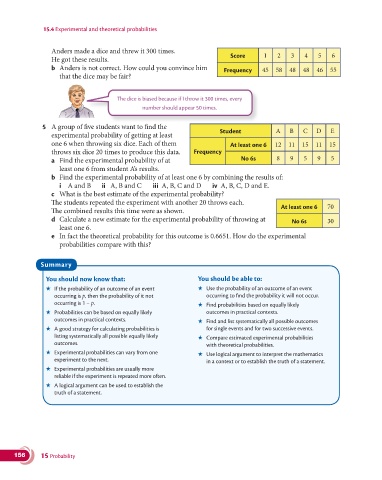
                  b   Anders is not correct. How could you convince him     Frequency    45  58   48  48   46  55
                     that the dice may be fair?


                                        The dice is biased because if I throw it 300 times, every
                                                 number should appear 50 times.


               5   A group of five students want to find the
                  experimental probability of getting at least            Student            A    B   C    D   E
                  one 6 when throwing six dice. Each of them                  At least one 6  12  11  15  11   15
                  throws six dice 20 times to produce this data.  Frequency
                  a   Find the experimental probability of at                    No 6s       8    9   5    9   5
                     least one 6 from student A’s results.
                  b  Find the experimental probability of at least one 6 by combining the results of:
                   i  A and B      ii  A, B and C   iii  A, B, C and D   iv  A, B, C, D and E.
                  c  What is the best estimate of the experimental probability?
                  The students repeated the experiment with another 20 throws each.            At least one 6  70
                  The combined results this time were as shown.
                  d   Calculate a new estimate for the experimental probability of throwing at    No 6s       30
                     least one 6.
                  e   In fact the theoretical probability for this outcome is 0.6651. How do the experimental
                     probabilities compare with this?


               Summary


                You should now know that:                          You should be able to:
                ★   If the probability of an outcome of an event    ★   Use the probability of an outcome of an event
                   occurring is p, then the probability of it not     occurring to find the probability it will not occur.
                   occurring is 1 − p.                             ★   Find probabilities based on equally likely
                ★   Probabilities can be based on equally likely      outcomes in practical contexts.
                   outcomes in practical contexts.                 ★   Find and list systematically all possible outcomes
                ★   A good strategy for calculating probabilities is    for single events and for two successive events.
                   listing systematically all possible equally likely   ★   Compare estimated experimental probabilities
                   outcomes.                                          with theoretical probabilities.
                ★   Experimental probabilities can vary from one   ★   Use logical argument to interpret the mathematics
                   experiment to the next.                            in a context or to establish the truth of a statement.
                ★   Experimental probabilities are usually more
                   reliable if the experiment is repeated more often.
                ★   A logical argument can be used to establish the
                   truth of a statement.


      156      15 Probability

