


Page 160 - MAT KS3 Y8 Cambridge CheckPoint
P. 160
16 Position and movement


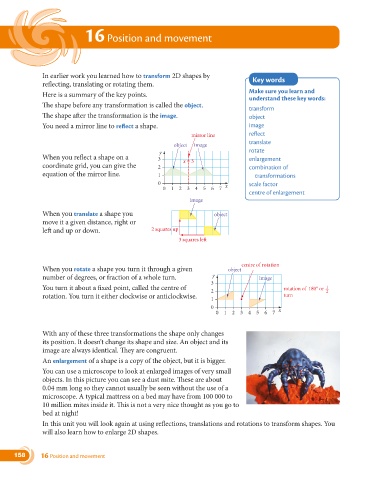
               In earlier work you learned how to transform 2D shapes by             Key words
               reflecting, translating or rotating them.
                                                                                    Make sure you learn and
               Here is a summary of the key points.
                                                                                    understand these key words:
               The shape before any transformation is called the object.
                                                                                    transform
               The shape after the transformation is the image.                     object

               You need a mirror line to reflect a shape.                            image
                                                                 mirror line        reflect
                                                                                    translate
                                                           object   image
                                                      y                             rotate
               When you reflect a shape on a          3       x = 3                 enlargement
               coordinate grid, you can give the      2                             co mbination of
               equation of the mirror line.           1                               transformations
                                                      0                             scale factor
                                                       0  1  2  3  4  5  6  7  x
                                                                                    centre of enlargement
                                                                image

               When you translate a shape you                            object
               move it a given distance, right or
               left and up or down.                 2 squares up
                                                             3 squares left


                                                                                  centre of rotation
               When you rotate a shape you turn it through a given           object
               number of degrees, or fraction of a whole turn.          y               image
                                                                       3
               You turn it about a fixed point, called the centre of                            rotation of  180° or  1
                                                                       2                                      2
               rotation. You turn it either clockwise or anticlockwise.                         turn
                                                                       1
                                                                       0
                                                                         0  1  2  3  4  5  6  7  x


               With any of these three transformations the shape only changes
               its position. It doesn’t change its shape and size. An object and its
               image are always identical. They are congruent.
               An enlargement of a shape is a copy of the object, but it is bigger.

               You can use a microscope to look at enlarged images of very small
               objects. In this picture you can see a dust mite. These are about
               0.04 mm long so they cannot usually be seen without the use of a
               microscope. A typical mattress on a bed may have from 100 000 to
               10 million mites inside it. This is not a very nice thought as you go to
               bed at night!

               In this unit you will look again at using reflections, translations and rotations to transform shapes. You
               will also learn how to enlarge 2D shapes.


      158      16 Position and movement

