


Page 159 - MAT KS3 Y8 Cambridge CheckPoint
P. 159
End-of-unit review


                 End-of-unit review


               1  If ten coins are spun together, the probability of four or more heads is 0.83.
                  The probability of eight or more heads is 0.05. Find the probability of:
                  a  less than four heads           b fewer than eight heads.

               2   Ahmad plays chess against his father. Ahmad’s probability of winning is 0.1. His probability
                  of losing is 0.3.
                  Find the probability that:
                  a  Ahmad will not win             b Ahmad’s father will not win.

               3   The letters of the word ‘EXPERIMENT’ are placed on ten separate cards. One card is chosen
                  at random.
                  a  How could you make sure the card is chosen at random?
                  b  Find the probability that the card does not show an E.
                  c  Find the probability that the letter on the card is in the word ‘EMPIRE’.
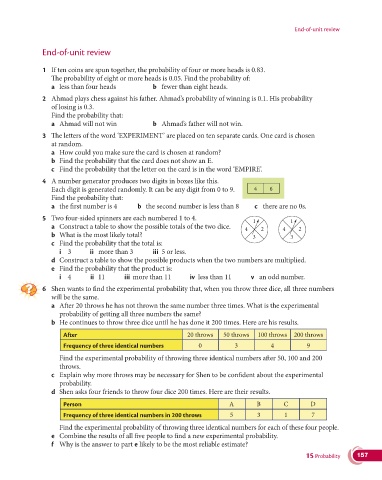
               4  A number generator produces two digits in boxes like this.
                  Each digit is generated randomly. It can be any digit from 0 to 9.  4    6
                  Find the probability that:
                  a  the first number is 4     b the second number is less than 8     c there are no 0s.

               5  Two four-sided spinners are each numbered 1 to 4.
                                                                                     1            1
                  a  Construct a table to show the possible totals of the two dice.  4  2      4     2
                  b  What is the most likely total?                                  3            3
                  c  Find the probability that the total is:
                   i  3        ii  more than 3      iii  5 or less.
                  d  Construct a table to show the possible products when the two numbers are multiplied.
                  e  Find the probability that the product is:
                   i  4        ii 11       iii  more than 11    iv  less than 11     v an odd number.

               6   Shen wants to find the experimental probability that, when you throw three dice, all three numbers
                  will be the same.
                  a   After 20 throws he has not thrown the same number three times. What is the experimental
                     probability of getting all three numbers the same?
                  b  He continues to throw three dice until he has done it 200 times. Here are his results.

                      After                                     20 throws   50 throws  100 throws  200 throws
                      Frequency of three identical numbers         0           3           4           9

                     Find the experimental probability of throwing three identical numbers after 50, 100 and 200
                     throws.
                  c   Explain why more throws may be necessary for Shen to be confident about the experimental
                     probability.
                  d  Shen asks four friends to throw four dice 200 times. Here are their results.

                      Person                                                  A        B        C        D
                      Frequency of three identical numbers in 200 throws      5        3        1        7
                     Find the experimental probability of throwing three identical numbers for each of these four people.
                  e  Combine the results of all five people to find a new experimental probability.
                  f  Why is the answer to part e likely to be the most reliable estimate?
                                                                                                       15 Probability   157

