


Page 161 - MAT KS3 Y8 Cambridge CheckPoint
P. 161
16.1 Transforming shapes


               16.1 Transforming shapes


               You can already transform 2D shapes by reflecting, translating or rotating them. You can also use a
               combination of transformations to transform a shape.


                Worked example 16.1
                                                                                        y
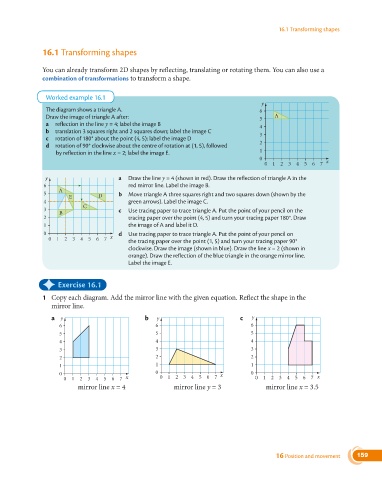
                  The diagram shows a triangle A.                                       6
                  Draw the image of triangle A after:                                   5    A
                a  reflection in the line y = 4; label the image B                       4
                b  translation 3 squares right and 2 squares down; label the image C    3
                c  rotation of 180 ° about the point (4, 5); label the image D
                d  rotation of 90 ° clockwise about the centre of rotation at (1, 5), followed    2
                    by reflection in the line x = 2; label the image E.                  1
                                                                                        0
                                                                                         01234567             x

                y                        a   Draw the line y = 4 (shown in red). Draw the reflection of triangle A in the
                6                           red mirror line. Label the image B.
                     A
                5                        b   Move triangle A three squares right and two squares down (shown by the
                        E         D
                4                           green arrows). Label the image C.
                             C
                3                        c   Use tracing paper to trace triangle A. Put the point of your pencil on the
                     B
                2                           tracing paper over the point (4, 5) and turn your tracing paper 180 °. Draw
                1                           the image of A and label it D.
                0                        d   Use tracing paper to trace triangle A. Put the point of your pencil on
                 01234567             x     the tracing paper over the point (1, 5) and turn your tracing paper 90 °
                                            clockwise. Draw the image (shown in blue). Draw the line x = 2 (shown in
                                            orange). Draw the reflection of the blue triangle in the orange mirror line.
                                            Label the image E.


               ✦     Exercise 16.1

               1   Copy each diagram. Add the mirror line with the given equation. Reflect the shape in the
                  mirror line.

                  a  y                           b   y                           c   y
                     6                               6                               6
                     5                               5                               5
                     4                               4                               4
                     3                               3                               3
                     2                               2                               2
                     1                               1                               1
                     0                               0                     x         0
                      0  1  2  3  4  5  6  7  x       01234567                        01234567             x

                           mirror line x = 4               mirror line y = 3              mirror line x = 3.5


                                                                                             16 Position and movement   159

