


Page 34 - MAT KS3 Y8 Cambridge CheckPoint
P. 34
3.1 Multiplying and dividing by 0.1 and 0.01


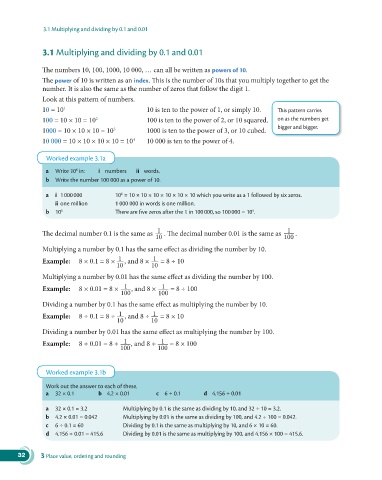
               3.1 Multiplying and dividing by 0.1 and 0.01


               The numbers 10, 100, 1000, 10 000, … can all be written as powers of 10.
               The power of 10 is written as an index. This is the number of 10s that you multiply together to get the
               number. It is also the same as the number of zeros that follow the digit 1.
               Look at this pattern of numbers.
                      1
               10 = 10                            10 is ten to the power of 1, or simply 10.  This pattern carries
               100 = 10 × 10 = 10                 100 is ten to the power of 2, or 10 squared.  on as the numbers get
                                 2
                                                                                              bigger and bigger.
                                       3
               1000 = 10 × 10 × 10 = 10           1000 is ten to the power of 3, or 10 cubed.
                                             4
               10 000 = 10 × 10 × 10 × 10 = 10     10 000 is ten to the power of 4.
                Worked example 3.1a

                          6
                a Write 10  in:   i numbers   ii words.
                b  Write the number 100 000 as a power of 10.

                                         6
                a  i  1 000 000        10  = 10 × 10 × 10 × 10 × 10 × 10 which you write as a 1 followed by six zeros.
                   ii one million      1 000 000 in words is one million.
                     5
                                                                                     5
                b 10                   There are five zeros after the 1 in 100 000, so 100 000 = 10 .
                                                      1                                          1
               The decimal number 0.1 is the same as    . The decimal number 0.01 is the same as    .
                                                     10                                         100
               Multiplying a number by 0.1 has the same effect as dividing the number by 10.

               Example:  8 × 0.1 = 8 ×   1  , and 8 ×   1   = 8 ÷ 10
                                        10          10
               Multiplying a number by 0.01 has the same effect as dividing the number by 100.

               Example:  8 × 0.01 = 8 ×   1  , and 8 ×   1   = 8 ÷ 100
                                         100          100
               Dividing a number by 0.1 has the same effect as multiplying the number by 10.
               Example:  8 ÷ 0.1 = 8 ÷   1  , and 8 ÷   1   = 8 × 10
                                        10         10
               Dividing a number by 0.01 has the same effect as multiplying the number by 100.

               Example:  8 ÷ 0.01 = 8 ÷   1  , and 8 ÷   1   = 8 × 100
                                         100          100


                Worked example 3.1b

                Work out the answer to each of these.
                a  32 × 0.1       b  4.2 × 0.01      c  6 ÷ 0.1      d 4.156 ÷ 0.01

                a  32 × 0.1 = 3.2         Multiplying by 0.1 is the same as dividing by 10, and 32 ÷ 10 = 3.2.
                b  4.2 × 0.01 = 0.042     Multiplying by 0.01 is the same as dividing by 100, and 4.2 ÷ 100 = 0.042.
                c 6 ÷ 0.1 = 60            Dividing by 0.1 is the same as multiplying by 10, and 6 × 10 = 60.
                d 4.156 ÷ 0.01 = 415.6    Dividing by 0.01 is the same as multiplying by 100, and 4.156 × 100 = 415.6.


       32      3 Place value, ordering and rounding

