


Page 31 - MAT KS3 Y8 Cambridge CheckPoint
P. 31
2.6 Deriving and using formulae


               10 a   Shen uses this formula to convert temperatures in degrees Celsius (°C) to degrees Fahrenheit (°F).

                                      C = 0.6F − 17.8       where:  C is the temperature in °C
                                                                   F is the temperature in °F.
                       Use the formula to work out the temperature in °C when the temperature in °F is:
                   i 20°F      ii 45°F    iii 82°F.

                  b  Anders knows this relationship between temperatures in °F and temperatures in °C.

                                       9C = 5F − 160        where:  F is the temperature in °F
                                                                    C is the temperature in °C.

                       Anders wants to know the temperature in °F when the temperature is 4°C.
                     This is what he writes.


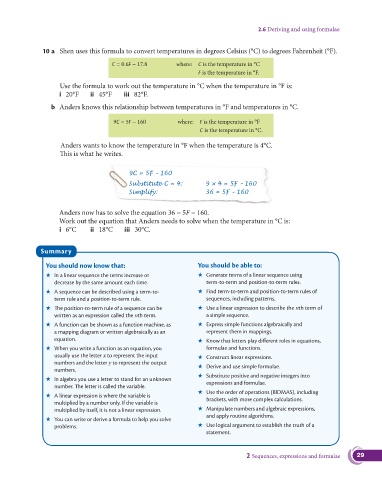
                                            9C = 5F – 160

                                            Substitute C = 4:         9 × 4 = 5F – 160
                                            Simplify:                 36 = 5F – 160


                     Anders now has to solve the equation 36 = 5F − 160.
                     Work out the equation that Anders needs to solve when the temperature in °C is:
                   i 6°C       ii 18°C     iii 30°C.


               Summary

                You should now know that:                          You should be able to:
                ★   In a linear sequence the terms increase or     ★   Generate terms of a linear sequence using
                   decrease by the same amount each time.             term-to-term and position-to-term rules.
                ★   A sequence can be described using a term-to-   ★   Find term-to-term and position-to-term rules of
                   term rule and a position-to-term rule.             sequences, including patterns.
                ★   The position-to-term rule of a sequence can be    ★   Use a linear expression to describe the nth term of
                   written as an expression called the nth term.      a simple sequence.
                ★   A function can be shown as a function machine, as   ★   Express simple functions algebraically and
                   a mapping diagram or written algebraically as an   represent them in mappings.
                   equation.                                       ★   Know that letters play different roles in equations,
                ★   When you write a function as an equation, you     formulae and functions.
                   usually use the letter x to represent the input    ★   Construct linear expressions.
                   numbers and the letter y to represent the output   ★   Derive and use simple formulae.
                   numbers.
                                                                   ★   Substitute positive and negative integers into
                ★   In algebra you use a letter to stand for an unknown
                                                                      expressions and formulae.
                   number. The letter is called the variable.
                                                                   ★   Use the order of operations (BIDMAS), including
                ★   A linear expression is where the variable is
                                                                      brackets, with more complex calculations.
                   multiplied by a number only. If the variable is
                   multiplied by itself, it is not a linear expression.  ★   Manipulate numbers and algebraic expressions,
                                                                      and apply routine algorithms.
                ★   You can write or derive a formula to help you solve
                   problems.                                       ★   Use logical argument to establish the truth of a
                                                                      statement.


                                                                                   2 Sequences, expressions and formulae  29

