


Page 26 - MAT KS3 Y8 Cambridge CheckPoint
P. 26
2.4 Using functions and mappings


               2.4 Using functions and mappings


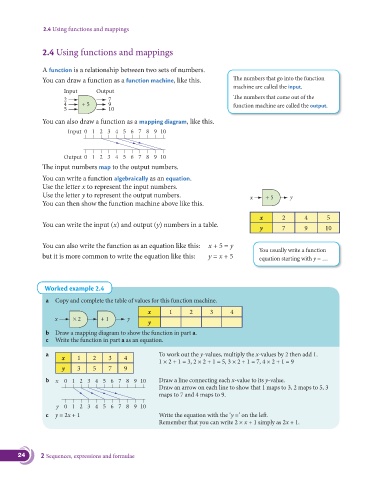
               A function is a relationship between two sets of numbers.
               You can draw a function as a function machine, like this.       The numbers that go into the function
                                                                               machine are called the input.
                      Input      Output
                      2              7                                         The numbers that come out of the
                      4     + 5      9                                         function machine are called the output.
                      5              10

               You can also draw a function as a mapping diagram, like this.
                        Input  01  23456789 10


                      Output  0 1  23456789 10
               The input numbers map to the output numbers.
               You can write a function algebraically as an equation.
               Use the letter x to represent the input numbers.
               Use the letter y to represent the output numbers.                    x     + 5     y
               You can then show the function machine above like this.
                                                                                        x      2       4      5
               You can write the input (x) and output (y) numbers in a table.           y      7       9      10


               You can also write the function as an equation like this:  x + 5 = y
                                                                                        You usually write a function
               but it is more common to write the equation like this:   y = x + 5       equation starting with y = …


                Worked example 2.4
                a  Copy and complete the table of values for this function machine.
                                                  x       1     2      3      4
                   x     × 2       + 1     y      y

                b  Draw a mapping diagram to show the function in part a.
                c  Write the function in part a as an equation.

                a     x    1    2    3    4             To work out the y-values, multiply the x-values by 2 then add 1.
                                                      1 × 2 + 1 = 3, 2 × 2 + 1 = 5, 3 × 2 + 1 = 7, 4 × 2 + 1 = 9
                      y    3    5    7    9

                b  x  01    23456789 10               Draw a line connecting each x-value to its y-value.
                                                        Draw an arrow on each line to show that 1 maps to 3, 2 maps to 5, 3
                                                      maps to 7 and 4 maps to 9.
                    y  0 1  23456789 10
                c  y = 2x + 1                           Write the equation with the ‘y =’ on the left.
                                                      Remember that you can write 2 × x + 1 simply as 2x + 1.


       24      2 Sequences, expressions and formulae

