


Page 21 - MAT KS3 Y8 Cambridge CheckPoint
P. 21
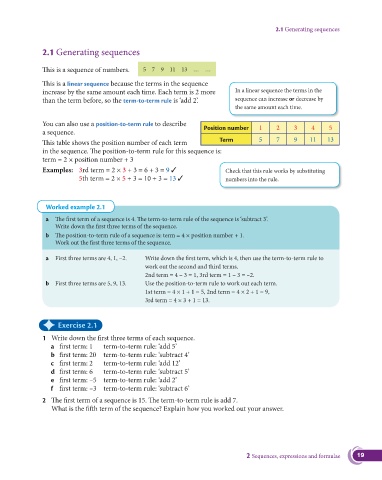
2.1 Generating sequences


               2.1 Generating sequences


               This is a sequence of numbers.    5 7 9 11 13 … …

               This is a linear sequence because the terms in the sequence
               increase by the same amount each time. Each term is 2 more       In a linear sequence the terms in the
               than the term before, so the term-to-term rule is ‘add 2’.       sequence can increase or decrease by
                                                                                the same amount each time.

               You can also use a position-to-term rule to describe
                                                                     Position number   1     2     3     4     5
               a sequence.
                                                                          Term         5     7     9    11    13
               This table shows the position number of each term
               in the sequence. The position-to-term rule for this sequence is:
               term = 2 × position number + 3
               Examples:   3rd term = 2 × 3 + 3 = 6 + 3 = 9 ✓               Check that this rule works by substituting
                           5th term = 2 × 5 + 3 = 10 + 3 = 13 ✓             numbers into the rule.


                Worked example 2.1

                a  The first term of a sequence is 4. The term-to-term rule of the sequence is ‘subtract 3’.
                   Write down the first three terms of the sequence.
                b  The position-to-term rule of a sequence is: term = 4 × position number + 1.
                   Work out the first three terms of the sequence.

                a  First three terms are 4, 1, –2.     Write down the first term, which is 4, then use the term-to-term rule to
                                                 work out the second and third terms.
                                                 2nd term = 4 – 3 = 1, 3rd term = 1 – 3 = –2.
                b  First three terms are 5, 9, 13.     Use the position-to-term rule to work out each term.
                                                 1st term = 4 × 1 + 1 = 5, 2nd term = 4 × 2 + 1 = 9,
                                                 3rd term = 4 × 3 + 1 = 13.


               ✦     Exercise 2.1


               1  Write down the first three terms of each sequence.
                  a  first term: 1   term-to-term rule: ‘add 5’
                  b  first term: 20  term-to-term rule: ‘subtract 4’
                  c  first term: 2   term-to-term rule: ‘add 12’
                  d  first term: 6   term-to-term rule: ‘subtract 5’
                  e  first term: –5  term-to-term rule: ‘add 2’
                  f  first term: –3  term-to-term rule: ‘subtract 6’

               2  The first term of a sequence is 15. The term-to-term rule is add 7.
                    What is the fifth term of the sequence? Explain how you worked out your answer.


                                                                                   2 Sequences, expressions and formulae  19

