


Page 25 - MAT KS3 Y8 Cambridge CheckPoint
P. 25
2.3 Using the nth term


               2.3 Using the nth term


               You already know how to work out the position-to-term rule of a linear sequence.
               Example: The sequence          5, 7, 9, 11, …, …
               has position-to-term rule:     term = 2 × position number + 3

               You can also write the position-to-term rule called the nth term.
               To do this, you replace the words ‘position number’ with the letter n.  n stands for the term number.

               So, in the example above,
               instead of writing             term = 2 × position number + 3
               you write:                     nth term is 2 × n + 3                   2 × n is usually written as 2n.
               or simply:                     nth term is 2n + 3


                Worked example 2.3

                The nth term of a sequence is 2n − 1. Work out the first three terms and the ninth term of the sequence.

                 1st term = 2 × 1 − 1 = 1        To find the first term, substitute n = 1 into the expression.
                 2nd term = 2 × 2 − 1 = 3        To find the second term, substitute n = 2 into the expression.
                 3rd term = 2 × 3 − 1 = 5        To find the third term, substitute n = 3 into the expression.
                 9th term = 2 × 9 − 1 = 17       To find the ninth term, substitute n = 9 into the expression.

               ✦     Exercise 2.3


               1  Work out the first three terms and the 10th term of the sequences with the given nth term.
                  a  n + 6         b  n − 3         c 4n             d 6n
                  e  2n + 5        f 3n − 1         g 5n + 3         h 4n − 3
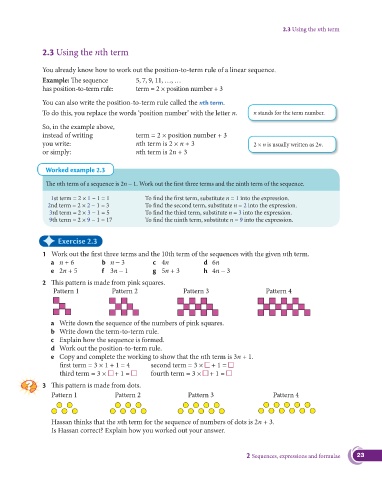
               2  This pattern is made from pink squares.
                   Pattern 1          Pattern 2               Pattern 3                   Pattern 4


                  a  Write down the sequence of the numbers of pink squares.
                  b  Write down the term-to-term rule.
                  c  Explain how the sequence is formed.
                  d  Work out the position-to-term rule.
                  e  Copy and complete the working to show that the nth term is 3n + 1.
                     first term = 3 × 1 + 1 = 4    second term = 3 ×   + 1 =
                     third term = 3 ×   + 1 =      fourth term = 3 ×   + 1 =

               3  This pattern is made from dots.
                  Pattern 1            Pattern 2                Pattern 3                   Pattern 4


                  Hassan thinks that the nth term for the sequence of numbers of dots is 2n + 3.
                  Is Hassan correct? Explain how you worked out your answer.


                                                                                   2 Sequences, expressions and formulae  23

