


Page 115 - Math;Steps 2: resource masters
P. 115
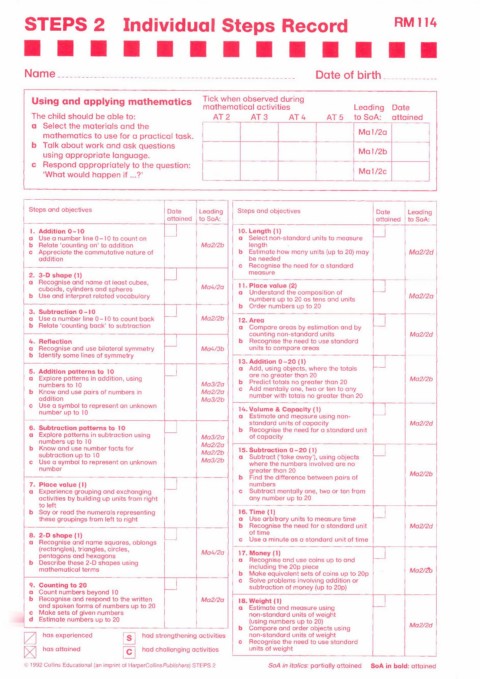
STEPS 2                  Individual              Steps Record                               RM 114
       ••• • •• • ••• • •


       Na me                                                             _     Date of birth                _


         Using and applying mathematics            Tick when observed during
                                                   mathematical activities               Leading  Date
         The child should be able to:                 AT 2     AT 3     AT 4      AT 5   to SoA:  attained
         a Select the materials and the
            mathematics to use for a practical task.                                      Ma1/2a
         b Talk about work and ask questions
            using appropriate language.                                                   Ma1/2b
         c  Respond appropriately to the question:
            'What would happen if ...?'                                                   Ma1/2c


        Steps and objectives              Date    Leading   Steps and objectives              Date    Leading
                                          attained  to SoA:                                   attained  to SoA:
        1. Addition  0 -1 0               0                 10. Length (1)                   U
        a  Use a number line 0 - 10 to count on             a  Select non-standard  units to measure
        b  Relate 'counting on' to addition        Ma212b      length
        c  Appreciate  the commutative  nature of           b  Estimate how many units (up to 20) may  Ma212d
           addition                                         c  be needed
                                                               Recognise the need for a standard
                                          U                    measure
        2. 3-D shape (1)
        a  Recognise and name at least cubes,               11. Place value (2)              U         --   -
           cuboids, cylinders and spheres          Ma412a   a  Understand  the composition  of
        b  Use and interpret related vocabulary                                                       Ma212a
                                                               numbers up to 20 as tens and units
        3. Subtraction  0 -1 0            U                 b  Order numbers up to 20
        a  Use a number line 0 - 10 to count back  Ma2/2b   12. Area                         U
        b  Relate 'counting back' to subtraction            a  Compare areas by estimation and by

                                                               Recognise the need to use standard
        4. Reflection                     U                 b  counting non-standard  units           Ma212d
        a  Recognise and use bilateral symmetry    Ma4/3b      units to compare areas
        b  Identify some lines of symmetry                  13. Addition  0 -20 (I)          U
                                          LJ                a  Add, using objects, where the totals
        5. Addition  patterns  to 10
        a  Explore patterns in addition, using              b  are no greater than 20                 Ma212b
                                                               Predict totals no greater than 20
           numbers to 10                           Ma312a
        b  Know and use pairs of numbers in        Ma2/2a   c  Add mentally one, two or ten to any
           addition                                Ma312b      number with totals no greater than 20
        c  Use a symbol to represent an unknown                                              U
           number up to 10                                  14. Volume & Capacity (I)
                                                            a
                                                               Estimate and measure using non-
        6. Subtraction  patterns  to 10   U                 b  standard units of capacity             Ma212d
                                                               Recognise the need for a standard unit
        a  Explore patterns in subtraction  using  Ma312a      of capacity
           numbers up to 10
        b  Know and use number facts for           Ma212a   15. Subtraction  0 - 20 (I)      U
           subtraction  up to 10                   Ma212b   a  Subtract ('take away'), using objects
        c  Use a symbol to represent an unknown    Ma312b      where the numbers involved are no
           number                                              greater than 20                        Ma212b
        7. Place value (1)                LJ                b  Find the difference between pairs of
                                                               numbers
        a  Experience grouping and exchanging               c  Subtract mentally one, two or ten from
           activities by building up units from right          any number up to 20
           to left
        b  Say or read the numerals representing            16. Time (1)                     U
           these groupings from left to right               a  Use arbitrary  units to measure time   Ma212d
                                                               Recognise the need for a standard unit
                                                            b
        8. 2-D shape (1)                  U                    of time
        a  Recognise and name squares, oblongs              c  Use a minute as a standard unit of time
           (rectangles), triangles, circles,                                                 U
           pentagons and hexagons                  Ma412a   17. Money (I)
        b  Describe these 2-D shapes using                  a  Recognise and use coins up to and
           mathematical  terms                              b  including the 20p piece                Ma21:!b
                                                               Make equivalent sets of coins up to 20p
                                          U                 c  Solve problems involving addition or
        q. Counting to 20                                      subtraction  of money (up to 20p)
        a  Count numbers beyond 10
        b  Recognise and respond to the written    Ma212a   18. Weight (1)                   U
           and spoken forms of numbers up to 20             a  Estimate and measure using
        c  Make sets of given numbers                          non-standard  units of weight
        d  Estimate numbers up to 20                           (using numbers up to 20)
                                                            b  Compare and order objects using        Ma212d
            has experienced         had strengthening  activities  non-standard  units of weight
                                                            c  Recognise the need to use standard
            has attained            had challenging activities  units of weight
       © 1992 Collins Educational  (an imprint of HarperCollinsPublishers)  STEPS 2  SoA in italics: partially attained  SoA in bold: attained

