


Page 116 - Math;Steps 2: resource masters
P. 116
----------------------------------------------------------------------------------------------------------------------------
                                                                                                   RMl15


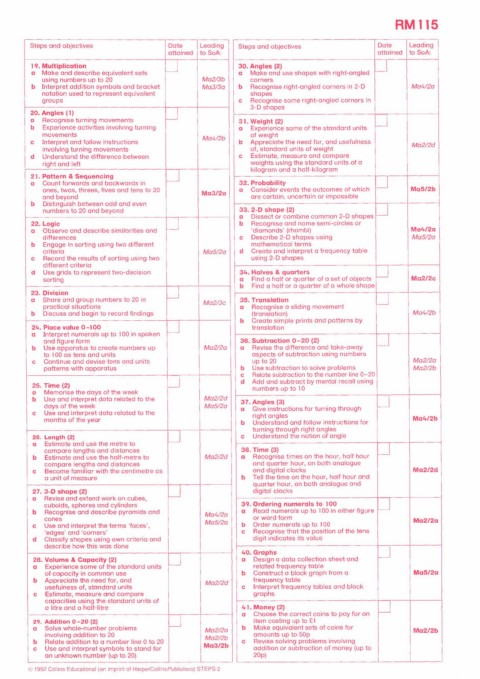
        Steps and objectives               Date   Leading   Steps and objectives              Date    Leading
                                           attained  to SoA:                                  attained  to SoA:
         1q. Multiplication                                 30. Angles (2)                    U
         a  Make and describe equivalent sets               a  Make and use shapes with right-angled
           using numbers up to 20                  Ma213b      corners
         b  Interpret addition symbols and bracket  Ma313a  b  Recognise right-angled  corners in 2-D  Ma412a
           notation used to represent equivalent               shapes
           groups                                           c  Recognise some right-angled  corners in
                                                               3-D shapes
        20. Angles (I)
        a  Recognise turning movements                      31. Weight  (2)                   D
         b  Experience activities involving turning         a  Experience some of the standard units
           movements                                           of weight
        c  Interpret and follow instructions       Ma412b   b  Appreciate  the need for, and usefulness  Ma212d
           involving turning movements                         of, standard units of weight
        d  Understand the difference between                c  Estimate, measure and compare
           right and left                                      weights using the standard units of a
                                                               kilogram and a half-kilogram
         21. Pattern  & Sequencing
         a  Count forwards and backwards  in                32. Probability                   U
           ones, twos, threes, fives and tens to 20  Ma3/2a  a  Consider events the outcomes of which  Ma5/2b
           and beyond                                          are certain, uncertain or impossible
         b  Distinguish between odd and even                                                  LJ
            numbers to 20 and beyond                        33.2-0  shape (2)
                                                            a  Dissect or combine common 2-D shapes
         22. Logic                                          b  Recognise and name semi-circles  or
         a  Observe and describe similarities  and             'diamonds'  (rhombi)                    Ma4/2a
            differences                                     c  Describe 2-D shapes using               Ma512a
         b  Engage in sorting using two different              mathematical  terms
            criteria                               Ma512a   d  Create and interpret a frequency table
         c  Record the results of sorting using two            using 2-D shapes
            different criteria
         d  Use grids to represent two-decision             34. Halves & quarters             U
            sorting                                         a  Find a half or quarter of a set of objects  Ma2/2c
                                                            b  Find a half or a quarter of a whole shape
         23. Division
         a  Share and group numbers to 20 in       Ma213c   35. Translation                   U
            practical situations                            a  Recognise a sliding movement
         b  Discuss and begin to record findings               (translation)                           Ma412b
                                                            b  Create simple prints and patterns by
         24. Place value 0-100                                 translation
         a  Interpret numerals up to I00 in spoken
            and figure form                                 36. Subtraction  0-20  (2)        U
         b  Use apparatus  to create numbers up    Ma212a   a  Revise the difference and take-away
            to 100 as tens and units                           aspects of subtraction  using numbers
         c  Continue and devise tens and units                 up to 20                                Ma212a
            patterns with apparatus                         b  Use subtraction  to solve problems      Ma212b
                                                            c  Relate subtraction to the number line 0-20
                                                            d  Add and subtract by mental recall using
         25. Time (2)                                          numbers up to 10
         a  Memorise the days of the week
         b  Use and interpret data related to the  Ma212d    37. Angles (3)                   U
            days of the week                       Ma512a    a  Give instructions for turning through
         c  Use and interpret data related to the              right angles
            months of the year                               b  Understand and follow instructions for  Ma4/2b
                                                               turning through right angles
         26. Length  (2)                                     c  Understand the notion of angle
         a  Estimate and use the metre to
            compare lengths and distances                    38. Time (3)                     U
         b  Estimate and use the half-metre to      Ma2/2d   a  Recognise times on the hour, half hour
            compare lengths and distances                      and quarter hour, on both analogue
         c  Become familiar with the centimetre as              and digital clocks                     Ma2/2d
            a unit of measure                                b  Tell the time on the hour, half hour and
                                                                quarter hour, on both analogue and
         27. 3-D shape (2)                                      digital clocks
         a  Revise and extend work on cubes,
            cuboids, spheres and cylinders                   3q. Ordering  numerals  to 100   U
         b  Recognise and describe pyramids and     Ma412a   a  Read numerals up to 100 in either figure
            cones                                               or word form                           Ma2/2a
         c  Use and interpret the terms 'faces',    Ma512a   b  Order numerals up to 100
            'edges' and 'corners'                            c  Recognise that the position of the tens
         d  Classify shapes using own criteria and              digit indicates its value
            describe how this was done
                                                             40. Graphs                        ~
         28. Volume & Capacity  (2)                          a  Design a data collection sheet and
         a  Experience some of the standard units               related frequency table
            of capacity in common use                        b  Construct a block graph from a         Ma5/2a
         b  AppreCiate the need for, and            Ma212d      frequency table
            usefulness of, standard units                    c  Interpret frequency tables and block
         c  Estimate, measure and compare                       graphs
            capacities  using the standard units of
            a litre and a half-litre                         41. Money (2)                    U
                                                             a  Choose the correct coins to pay for an
         2q. Addition  0 -20  (2)                               item costing up to £ I
         a  Solve whole-number  problems            Ma2/2a   b  Make equivalent sets of coins for      Ma2/2b
            involving addition to 20                Ma2/2b      amounts up to SOp
         b  Relate addition to a number line 0 to 20         c  Revise solving problems involving
         c  Use and interpret symbols to stand for  Ma3/2b      addition or subtraction  of money (up to
            an unknown number (up to 20)                        20p)
        © 1992 Collins Educational  (an imprint of HarperCollinsPublishers)  STEPS 2

