


Page 35 - Banking Finance February 2026
P. 35
ARTICLE

         and pay later - a radical innovation that ushered in modern  4. Smarter and Safer: Chip Cards (1980s-1990s)
         consumer credit.                                     To tackle fraud, France pioneered smart cards with micro-
                                                              processors in the
         2. Plastic Money and Bank-Issued Credit              1980s. These "chip-
         (1950s-1960s)                                        and-PIN" cards re-
         The real breakthrough came with bank-issued credit cards.  quired both posses-
         In 1958, Ameri-                                      sion of the card and
         can     Express                                      entry of a secret
         launched its first                                   code, enhancing
         charge card, en-                                     security.
         abling monthly
         bill payments.                                       Building on this, Visa, Mastercard, and Europay collaborated
         Around the same                                      in 1994 to establish a global chip standard known as EMV
         time, Bank of                                        (Europay-Mastercard-Visa). By 1996, chip-enabled cards
         America intro-                                       began rolling out, capable of generating dynamic codes for
         duced BankAmericard, the first true credit card allowing  each transaction - making counterfeiting extremely difficult.
         "revolving credit." Customers could carry forward balances,  This era also saw the ATM boom, further embedding plastic
         paying interest on unpaid amounts - the model that remains  cards into everyday financial life.
         central to credit cards even today.
                                                              5. The Age of Contactless and Mobile Payments
         BankAmericard, later renamed Visa, marked the shift from  (2000s-2010s)
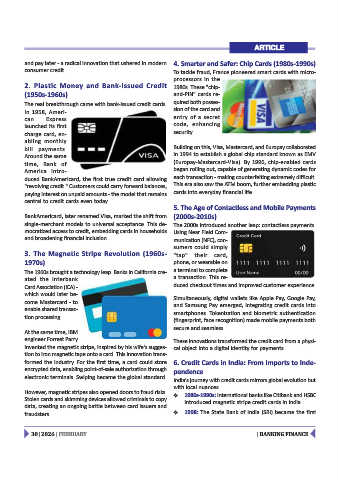
         single-merchant models to universal acceptance. This de-  The 2000s introduced another leap: contactless payments.
         mocratized access to credit, embedding cards in households  Using Near Field Com-
         and broadening financial inclusion.                  munication (NFC), con-
                                                              sumers could simply
         3. The Magnetic Stripe Revolution (1960s-            "tap" their card,
         1970s)                                               phone, or wearable on
         The 1960s brought a technology leap. Banks in California cre-  a terminal to complete
         ated the Interbank                                   a transaction. This re-
         Card Association (ICA) -                             duced checkout times and improved customer experience.
         which would later be-                                Simultaneously, digital wallets like Apple Pay, Google Pay,
         come Mastercard - to
                                                              and Samsung Pay emerged, integrating credit cards into
         enable shared transac-
         tion processing.                                     smartphones. Tokenization and biometric authentication
                                                              (fingerprint, face recognition) made mobile payments both
                                                              secure and seamless.
         At the same time, IBM
         engineer Forrest Parry                               These innovations transformed the credit card from a physi-
         invented the magnetic stripe, inspired by his wife's sugges-  cal object into a digital identity for payments.
         tion to iron magnetic tape onto a card. This innovation trans-
         formed the industry. For the first time, a card could store  6. Credit Cards in India: From Imports to Inde-
         encrypted data, enabling point-of-sale authorization through
                                                              pendence
         electronic terminals. Swiping became the global standard.
                                                              India's journey with credit cards mirrors global evolution but
                                                              with local nuances.
         However, magnetic stripes also opened doors to fraud risks.
         Stolen cards and skimming devices allowed criminals to copy  Y  1980s-1990s: International banks like Citibank and HSBC
         data, creating an ongoing battle between card issuers and  introduced magnetic stripe credit cards in India.
         fraudsters.                                          Y  1998: The State Bank of India (SBI) became the first


            30 | 2026 | FEBRUARY                                                           | BANKING FINANCE

