


Page 38 - The Insurance Times February 2026
P. 38
refinements in pricing, underwriting logic, and customer  Insurance Function  AI Application
         experience responding more dynamically to changing needs
         and risks.                                            Underwriting         Risk scoring, dynamic pricing,
                                                                                    segmentation
           Stage       Primary Focus Key Characteristics       Claims               Automated triage, fraud
                                                                                    detection, damage assessment
           Digitisation  Efficiency  Online issuance, digital
                                     KYC, automated            Customer Service     NLP-based chat and query
                                     workflows                                      resolution
           Automation  Speed & Scale Rule-based underwriting,  Risk & Compliance    Pattern recognition, anomaly
                                     straight-through                               detection
                                     processing
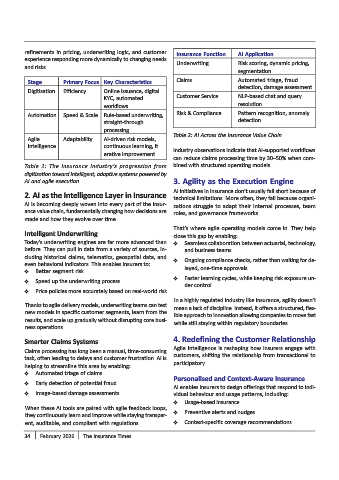
                                                              Table 2: AI Across the Insurance Value Chain.
           Agile       Adaptability  AI-driven risk models,
           Intelligence              continuous learning, it
                                     erative improvement      Industry observations indicate that AI-supported workflows
                                                              can reduce claims processing time by 30–50% when com-
         Table 1: The insurance industry’s progression from   bined with structured operating models.
         digitisation toward intelligent, adaptive systems powered by
         AI and agile execution.                              3. Agility as the Execution Engine
                                                              AI initiatives in insurance don’t usually fall short because of
         2. AI as the Intelligence Layer in Insurance
                                                              technical limitations. More often, they fail because organi-
         AI is becoming deeply woven into every part of the insur-  zations struggle to adapt their internal processes, team
         ance value chain, fundamentally changing how decisions are  roles, and governance frameworks.
         made and how they evolve over time.
                                                              That’s where agile operating models come in. They help
         Intelligent Underwriting                             close this gap by enabling:
         Today’s underwriting engines are far more advanced than  Y  Seamless collaboration between actuarial, technology,
         before. They can pull in data from a variety of sources, in-  and business teams
         cluding historical claims, telematics, geospatial data, and
                                                              Y  Ongoing compliance checks, rather than waiting for de-
         even behavioral indicators. This enables insurers to:
                                                                 layed, one-time approvals
         Y   Better segment risk
                                                              Y  Faster learning cycles, while keeping risk exposure un-
         Y   Speed up the underwriting process
                                                                 der control
         Y   Price policies more accurately based on real-world risk
                                                              In a highly regulated industry like insurance, agility doesn’t
         Thanks to agile delivery models, underwriting teams can test  mean a lack of discipline. Instead, it offers a structured, flex-
         new models in specific customer segments, learn from the  ible approach to innovation allowing companies to move fast
         results, and scale up gradually without disrupting core busi-  while still staying within regulatory boundaries.
         ness operations.

                                                              4. Redefining the Customer Relationship
         Smarter Claims Systems
                                                              Agile Intelligence is reshaping how insurers engage with
         Claims processing has long been a manual, time-consuming
         task, often leading to delays and customer frustration. AI is  customers, shifting the relationship from transactional to
         helping to streamline this area by enabling:         participatory.
         Y   Automated triage of claims
                                                              Personalised and Context-Aware Insurance
         Y   Early detection of potential fraud
                                                              AI enables insurers to design offerings that respond to indi-
         Y   Image-based damage assessments                   vidual behaviour and usage patterns, including:
                                                              Y  Usage-based insurance
         When these AI tools are paired with agile feedback loops,
                                                              Y  Preventive alerts and nudges
         they continuously learn and improve while staying transpar-
         ent, auditable, and compliant with regulations.      Y  Context-specific coverage recommendations

         34    February 2026  The Insurance Times

