Page 76 - moondani kyema
P. 76
ndani kyema, My Story - Ray Moore 76
In Sydney my journey led me into a jungle of culture shock where I got lost. It should
have been the best of times because this was only the second time that all six
members of our family had lived together. The previous occasion we had been
together as a family was in the year immediately after the War. During the War I had
been away from them in a boarding school and Japanese Concentration Camps for
six years. My little brother was less than a year old when I left in 1940, and my sister
was born during the War.
And now, by the end of 1950 we were together as a family for only the second time.
You would think that it would be a time when we would enjoy “home life”. But it
wasn’t. We were a somewhat dysfunctional family. Percy was a rather distant and
sometimes non-existent member of the family. I was now a teenager and not coping
very well with experiences which had ebbed and flowed around me for the last ten
years. Amy was a stable influence, but unable to show affection in any warmly
physical way, except to the two younger children. At one stage, I think that I was
trying to get some sort of personal physical acknowledgement from Amy, so I told her
that I had pimples on my back, and would she please rub some ointment on them.
She did this, but of course it did not achieve what I so clumsily and to some extent
subconsciously, sought.
My youngest brother was twelve and racing to catch up with the events that had
rushed over his young life. He went faithfully to the State School down the end of our
street and came home with exciting stories of Mr. Edwards his teacher who had been
a “war hero”. Percy whose communication with us, when it occurred, was to joke,
used to say that Mr. Edwards’ heroism consisted of being “surrounded by one Jap!”
My brother found his new Australian friends challenging and not always a good
influence. My parents received a phone call one afternoon to say that he had been
nabbed pinching things from Woolworths. My other brother escaped in a more
healthy way by getting involved in boy’s clubs in our church. He was 15 and went to
a Boys’ High School. He coped with the situation by being aggressive and
competitive. My little
sister at eight was an
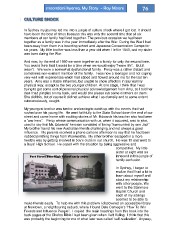
Fort Street Boys High School early 1950s innocent in this jungle of
family confusion.
In Sydney, I began to
realize that I had a lot to
learn about myself and
about my relationship
with other people. We
went to the Stanmore
Baptist Church and
each of my siblings
seemed to be able to
make friends easily. To help me with this problem I discovered an accessible library
at Newtown, a neighbouring suburb, where I found Dale Carnegie’s “How To Win
Friends and Influence People”. I copied the main headings from this book into the
back pages of the Chefoo Bible I had been given when I left Kuling. I think that this
was probably the beginning for me of what later was called ‘self-realization’. Anyway,
In Sydney my journey led me into a jungle of culture shock where I got lost. It should
have been the best of times because this was only the second time that all six
members of our family had lived together. The previous occasion we had been
together as a family was in the year immediately after the War. During the War I had
been away from them in a boarding school and Japanese Concentration Camps for
six years. My little brother was less than a year old when I left in 1940, and my sister
was born during the War.
And now, by the end of 1950 we were together as a family for only the second time.
You would think that it would be a time when we would enjoy “home life”. But it
wasn’t. We were a somewhat dysfunctional family. Percy was a rather distant and
sometimes non-existent member of the family. I was now a teenager and not coping
very well with experiences which had ebbed and flowed around me for the last ten
years. Amy was a stable influence, but unable to show affection in any warmly
physical way, except to the two younger children. At one stage, I think that I was
trying to get some sort of personal physical acknowledgement from Amy, so I told her
that I had pimples on my back, and would she please rub some ointment on them.
She did this, but of course it did not achieve what I so clumsily and to some extent
subconsciously, sought.
My youngest brother was twelve and racing to catch up with the events that had
rushed over his young life. He went faithfully to the State School down the end of our
street and came home with exciting stories of Mr. Edwards his teacher who had been
a “war hero”. Percy whose communication with us, when it occurred, was to joke,
used to say that Mr. Edwards’ heroism consisted of being “surrounded by one Jap!”
My brother found his new Australian friends challenging and not always a good
influence. My parents received a phone call one afternoon to say that he had been
nabbed pinching things from Woolworths. My other brother escaped in a more
healthy way by getting involved in boy’s clubs in our church. He was 15 and went to
a Boys’ High School. He coped with the situation by being aggressive and
competitive. My little
sister at eight was an
Fort Street Boys High School early 1950s innocent in this jungle of
family confusion.
In Sydney, I began to
realize that I had a lot to
learn about myself and
about my relationship
with other people. We
went to the Stanmore
Baptist Church and
each of my siblings
seemed to be able to
make friends easily. To help me with this problem I discovered an accessible library
at Newtown, a neighbouring suburb, where I found Dale Carnegie’s “How To Win
Friends and Influence People”. I copied the main headings from this book into the
back pages of the Chefoo Bible I had been given when I left Kuling. I think that this
was probably the beginning for me of what later was called ‘self-realization’. Anyway,