


Page 4 - Sisk News August 2017
P. 4
 Our journey to zero
A
Ab
b
r
ri
i
e
ef
f
h
hi
i
s
s
t
t
o
or
ry
ya
an
nd
d
c
c
u
ur
r
r
r
e
en
nt
ts
sn
na
ap
p
s
s
h
h
o
o
t
t
   k
practices across all of the things we do.
During the 1970s and 1980s, Sisk’s work in Ireland with Pharmaceutical and multi-national companies investing in Ireland demanded strict health and safety standards. Inspired by these working practices, Sisk has since led the way in HS&W.
Expansion to the UK in the mid-1980s, where the HS&W environment was more tightly regulated, gave us another opportunity to share practices and raise the benchmark.
1994 and 1995 saw the introduction of European harmonisation safety directives, which had a major impact on the construction industry; this created another catalyst for Sisk to review its HS&W commitments. As a result, company safety teams were established and we introduced certi ed, high quality standards and procedures. At the same time, we invested in upskilling our staff and supply chain in the critical safety and statutory competencies.
Different times
1995 also saw Dave O’Riordan join as our  rst safety advisor, based in Ireland South.
O
O
v
ve
e
r
rt
t
h
h
e
ep
pa
a
s
s
t
tf
f
o
o
r
rt
ty
yy
ye
e
a
ar
r
s
s,
,S
Si
is
sk
h
h
a
as
s
b
b
e
e
e
e
n
n
w
wo
or
rk
k
i
i
n
ng
g
t
t
i
ir
re
e
l
l
e
e
s
s
s
s
l
ly
y
t
to
o
i
i
m
m
p
p
r
r
o
ov
ve
eh
h
e
e
a
al
lt
th
h,
,s
sa
af
fe
e
t
ty
ya
an
n
d
d
w
w
e
el
lf
fa
a
r
r
e
e
(
(H
HS
S&
&
W
W)
)
   “I started in 1995 with Sisk in Johnson & Johnson (Vistakon), Limerick. At that time, there were only sporadic audits carried out on sites. There was no visible safety culture and some people looked at HS&W as a thorn in the side.
“Some things that happened on my watch in early those days; when we originally started mandating the wearing of helmets these were used as vessels to carry nails, water (no vents), and even some of our engineers used them to carry lime to mark out an excavation.”
Continuous improvement
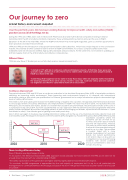
The period between 2000 and 2010 saw a continuous reduction in the Accident Frequency Rate (AFR) of reportable accidents, re ecting an improving safety environment. These improving work environments helped us to compete with international contractors during a time when pre-quali cation for Pharma, government-led or major infrastructure projects demanded high levels of safety performance.
The credit crunch and subsequent recession hit in 2008. Turning a negative into a positive, George Sisk used the  nancial downturn to encourage reviews of business ef ciencies and improvements in HS&W. The result was that in 2010, we launched the Zero Philosophy, Zero Incidents Zero Injuries, based on our belief that accidents are preventable. This philosophy remains at the core of our practices today. Since 2014, we have supplemented our Zero approach with the behavioural-based programme where the safety cultures and beliefs around Zero are being instilled, as well as encouraging our leaders, supervisors and workforce to “open their minds to safety”: the ultimate goal of getting home safely each day.
Also in 2014, we began to measure new leading indicators in safety such as the use of our behavioural code, director tours and scored safety audits. We began to measure Lost Time Accidents (LTA) alongside our Accident Frequency Rate (AFR). AFR measured reportable accidents where the operative can be off work for up to three and seven days in Ireland and the UK respectively, whereas LTA picks up more minor incidents that result in the operative being off work for up to a day. This provided a tougher target with a more precise measurement of accident trends. Our current performance in AF and LT rates is in line with our competitors but we are still having incidents with severe potential and our commitment to Zero must
remain very strong.
                                                                                                           There is a big difference today
Dave O’Riordan sees big changes to date.
“In my opinion, the Behaviour Based Safety (BBS) approach would probably not have worked in the1990s as we were not far enough down the road with our understanding of HS&W.
“The safety expectations of this generation are higher and they rightly deserve to be treated with respect.
“To conclude, the BBS programme is appreciated by the vast majority of employees but it is up to us all, particularly site management, to continually reinforce the message, because if we don’t it will get lost. It has to be second nature to all of us; part of our DNA.”
 4 Sisk News | August 2017


