


Page 299 - American Stories, A History of the United States
P. 299
On MyHistoryLab                                                           Study and Review on MyHistoryLab


                    Chapter Review                                       Timeline


                  The World of Southern blacks
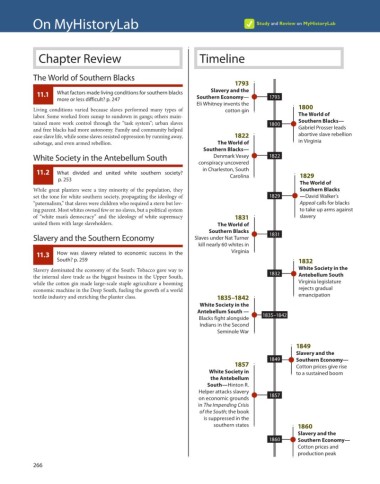
                                                                                     1793

                     11.1    What factors made living conditions for southern blacks   Slavery and the
                          more or less difficult? p. 247                Southern Economy—       1793
                                                                        eli Whitney invents the
                  Living  conditions varied because slaves performed many types of   cotton gin           1800
                  labor. Some worked from sunup to sundown in gangs; others main-                         The World of
                  tained more work control through the “task system”; urban slaves              1800      Southern blacks—
                  and free blacks had more autonomy. Family and community helped                          Gabriel Prosser leads
                  ease slave life, while some slaves resisted oppression by running away,   1822          abortive slave rebellion
                  sabotage, and even armed rebellion.                          The World of               in Virginia
                                                                          Southern blacks—
                  White Society in the Antebellum South                       Denmark Vesey     1822
                                                                         conspiracy uncovered
                                                                          in Charleston, South
                    11.2   What divided and united white southern society?         Carolina               1829
                           p. 253
                                                                                                          The World of
                  While great planters were a tiny minority of the population, they                       Southern blacks
                  set the tone for white southern society, propagating the ideology of          1829      —David Walker’s
                  “paternalism,” that slaves were children who required a stern but lov-                  Appeal calls for blacks
                  ing parent. Most whites owned few or no slaves, but a political system                  to take up arms against
                  of “white man’s democracy” and the ideology of white supremacy     1831                 slavery
                  united them with large slaveholders.                         The World of
                                                                            Southern blacks     1831
                  Slavery and the Southern economy                      Slaves under Nat Turner
                                                                         kill nearly 60 whites in
                    11.3    How was slavery related to economic success in the      Virginia
                          South? p. 259                                                                   1832
                  Slavery dominated the economy of the South: Tobacco gave way to                         White Society in the
                  the internal slave trade as the biggest business in the Upper South,          1832      Antebellum South
                  while the cotton gin made large-scale staple agriculture a booming                      Virginia legislature
                  economic machine in the Deep South, fueling the growth of a world                       rejects gradual
                  textile industry and enriching the planter class.            1835–1842                  emancipation
                                                                         White Society in the
                                                                        Antebellum South —
                                                                         blacks fight alongside   1835–1842
                                                                         indians in the Second
                                                                               Seminole War
                                                                                                         1849
                                                                                                         Slavery and the
                                                                                                1849     Southern Economy—
                                                                                     1857                Cotton prices give rise
                                                                            White Society in             to a sustained boom
                                                                             the Antebellum
                                                                            South—Hinton R.
                                                                         Helper attacks slavery
                                                                         on economic grounds    1857
                                                                         in The Impending Crisis
                                                                         of the South; the book
                                                                           is suppressed in the
                                                                              southern states            1860
                                                                                                         Slavery and the
                                                                                                1860     Southern Economy—
                                                                                                         Cotton prices and
                                                                                                         production peak
                  266

