


Page 303 - American Stories, A History of the United States
P. 303
12.1


            12.2


            12.3


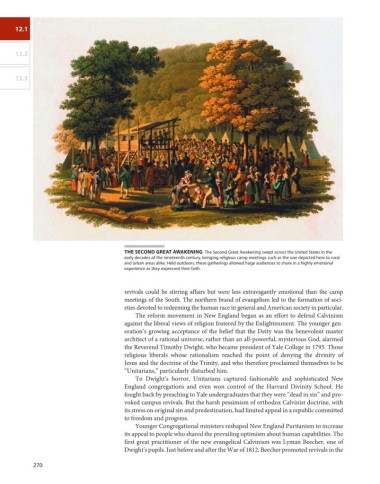
                                                The SeConD gReaT aWakening  The second Great Awakening swept across the United states in the
                                                early decades of the nineteenth century, bringing religious camp meetings such as the one depicted here to rural
                                                and urban areas alike. Held outdoors, these gatherings allowed huge audiences to share in a highly emotional
                                                experience as they expressed their faith.


                                                revivals could be stirring affairs but were less extravagantly emotional than the camp
                                                meetings of the South. The northern brand of evangelism led to the formation of soci-
                                                eties devoted to redeeming the human race in general and American society in particular.
                                                    The reform movement in New England began as an effort to defend Calvinism
                                                against the liberal views of religion fostered by the Enlightenment. The younger gen-
                                                eration’s growing acceptance of the belief that the Deity was the benevolent master
                                                architect of a rational universe, rather than an all-powerful, mysterious God, alarmed
                                                the Reverend Timothy Dwight, who became president of Yale College in 1795. Those
                                                religious liberals whose rationalism reached the point of denying the divinity of
                                                Jesus and the doctrine of the Trinity, and who therefore proclaimed themselves to be
                                                “ Unitarians,” particularly disturbed him.
                                                    To  Dwight’s  horror,  Unitarians  captured  fashionable  and  sophisticated  New
                                                  England congregations and even won control of the Harvard Divinity School. He
                                                fought back by preaching to Yale undergraduates that they were “dead in sin” and pro-
                                                voked campus revivals. But the harsh pessimism of orthodox Calvinist doctrine, with
                                                its stress on original sin and predestination, had limited appeal in a republic committed
                                                to freedom and progress.
                                                    Younger Congregational ministers reshaped New England Puritanism to increase
                                                its appeal to people who shared the prevailing optimism about human capabilities. The
                                                first great practitioner of the new evangelical Calvinism was Lyman Beecher, one of
                                                Dwight’s pupils. Just before and after the War of 1812, Beecher promoted revivals in the

                  270

