


Page 306 - American Stories, A History of the United States
P. 306
this exposé, an asylum was established to redeem “abandoned women.” Middle-class
                    women shifted the focus of this crusade to the men who patronized prostitutes and                      12.1
                    proposed that observers record and publish the names of men seen entering brothels.
                    The plan was abandoned because it offended those who thought that suppressing pub-
                    lic discussion and investigation of sexual vices would better serve the cause of virtue.               12.2
                       Beecher was especially influential in the temperance movement, the most successful   temperance
                    reform crusade; his sermons against drink were the most important and widely distributed   movement  Temperance—
                    of the early tracts calling for total abstinence from “demon rum.” The temperance move-  moderation or abstention in   12.3
                    ment was directed at a real social evil. Since the Revolution, whiskey had become the most   the consumption of alcoholic
                                                                                               beverages—attracted many
                    popular American beverage. Made from corn by farmers or, by the 1820s, in commercial   advocates in the early nineteenth
                    distilleries, it was cheaper than milk or beer and safer than water (which was often con-  century (see Second great
                    taminated). In some areas, rum and brandy were also popular. Hard liquor was frequently   awakening).
                    consumed with food as a table beverage, even at breakfast, and children sometimes imbibed
                    along with adults. Per capita annual consumption of distilled beverages in the 1820s was
                    almost triple what it is today, and alcoholism had reached epidemic proportions.
                       The temperance reformers viewed drinking as a threat to public morality. Drunk-
                    enness was seen as a loss of self-control and moral responsibility that spawned crime,
                    vice, and disorder. Above all, it threatened the family. Drinking was mainly a male
                    vice, and the main target of temperance propaganda was the husband and father who
                    abused, neglected, or abandoned his wife and children because he was a slave to the
                    bottle. Women played a vital role in the movement and in making it a crusade for


                         Watch the Video   Drinking and the Temperance Movement in nineteenth-Century America


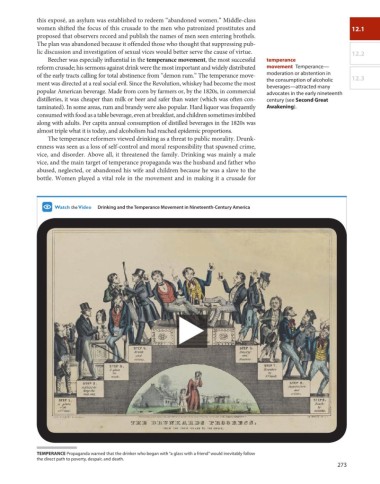
                    TeMpeRanCe Propaganda warned that the drinker who began with “a glass with a friend” would inevitably follow
                    the direct path to poverty, despair, and death.
                                                                                                                       273

