


Page 309 - American Stories, A History of the United States
P. 309
12.1                                            Read the Document    Catharine e. Beecher, “A Treatise on Domestic economy,
                                                                            for the Use of Young Ladies at home, and at School” (1841)

            12.2


            12.3


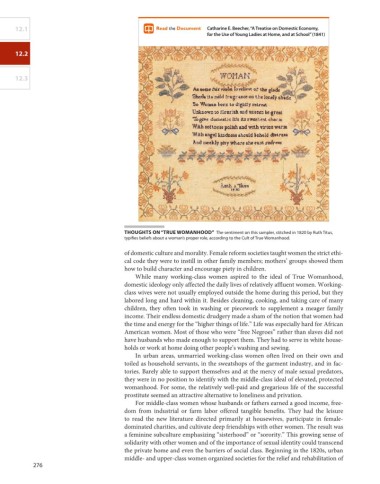
                                                ThoUghTS on “TRUe WoManhooD”  The sentiment on this sampler, stitched in 1820 by Ruth Titus,
                                                typifies beliefs about a woman’s proper role, according to the Cult of True Womanhood.
                                                of domestic culture and morality. Female reform societies taught women the strict ethi-
                                                cal code they were to instill in other family members; mothers’ groups showed them
                                                how to build character and encourage piety in children.
                                                    While many working-class women aspired to the ideal of True Womanhood,
                                                domestic ideology only affected the daily lives of relatively affluent women. Working-
                                                class wives were not usually employed outside the home during this period, but they
                                                labored long and hard within it. Besides cleaning, cooking, and taking care of many
                                                children, they often took in washing or piecework to supplement a meager family
                                                income. Their endless domestic drudgery made a sham of the notion that women had
                                                the time and energy for the “higher things of life.” Life was especially hard for African
                                                American women. Most of those who were “free Negroes” rather than slaves did not
                                                have husbands who made enough to support them. They had to serve in white house-
                                                holds or work at home doing other people’s washing and sewing.
                                                    In urban areas, unmarried working-class women often lived on their own and
                                                toiled as household servants, in the sweatshops of the garment industry, and in fac-
                                                tories. Barely able to support themselves and at the mercy of male sexual predators,
                                                they were in no position to identify with the middle-class ideal of elevated, protected
                                                womanhood. For some, the relatively well-paid and gregarious life of the successful
                                                prostitute seemed an attractive alternative to loneliness and privation.
                                                    For middle-class women whose husbands or fathers earned a good income, free-
                                                dom from industrial or farm labor offered tangible benefits. They had the leisure
                                                to  read  the  new  literature  directed  primarily  at  housewives,  participate  in  female-
                                                dominated charities, and cultivate deep friendships with other women. The result was
                                                a feminine subculture emphasizing “sisterhood” or “sorority.” This growing sense of
                                                solidarity with other women and of the importance of sexual identity could transcend
                                                the  private home and even the barriers of social class. Beginning in the 1820s, urban
                                                middle- and upper-class women organized societies for the relief and rehabilitation of
                  276

